
Call us
301-363-4651 (Available 9 a.m. to 5 p.m. CST from Monday to Friday)

| Code | CSB-RA190088A0HU |
| Size | US$210 |
| Order now | |
| Image |
|
| Have Questions? | Leave a Message or Start an on-line Chat |
| Application | Recommended Dilution |
|---|---|
| WB | 1:500-1:5000 |
| IF | 1:20-1:200 |
EIF4A1, also known as eukaryotic initiation factor 4A-I, serves as a critical ATP-dependent RNA helicase that plays an essential role in translation initiation. By unwinding secondary structures in the 5' untranslated region of mRNAs, this enzyme enables ribosome scanning and efficient protein synthesis. Given its involvement in regulating gene expression at the translational level, EIF4A1 has become an important target for researchers investigating cellular growth, stress responses, and the mechanisms underlying aberrant protein synthesis in disease states.
This recombinant monoclonal antibody, clone 7C3, offers the reproducibility and consistency that demanding experimental workflows require. Because the antibody sequence is defined and produced recombinantly in rabbit, you can expect uniform performance across lots, eliminating the variability that can complicate long-term studies or multi-site collaborations.
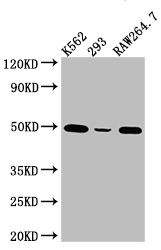
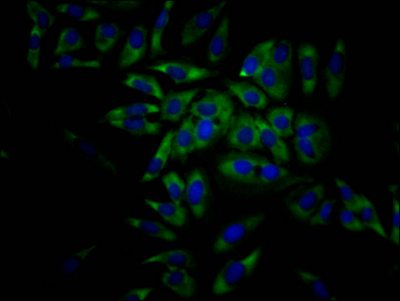
Validation testing demonstrates reliable detection across multiple experimental platforms. In western blot applications, the antibody successfully identifies EIF4A1 in K562, HEK293, and RAW264.7 whole cell lysates at dilutions ranging from 1:500 to 1:5000. The observed band at approximately 50 kDa runs slightly higher than the predicted molecular weight of 40-47 kDa, which likely reflects post-translational modifications such as glycosylation or phosphorylation events common to this protein. Immunofluorescence studies in HeLa cells confirm cytoplasmic localization patterns consistent with EIF4A1's known distribution, with recommended dilutions between 1:20 and 1:200.
Whether you are exploring translational control mechanisms, investigating stress granule dynamics, or examining broader questions in epigenetics and nuclear signaling, this antibody provides a dependable tool for advancing your research objectives.
There are currently no reviews for this product.





