
Call us
301-363-4651 (Available 9 a.m. to 5 p.m. CST from Monday to Friday)

| Code | CSB-RA986451A0HU |
| Size | US$210 |
| Order now | |
| Image |
|
| Have Questions? | Leave a Message or Start an on-line Chat |
| Application | Recommended Dilution |
|---|---|
| WB | 1:500-1:5000 |
| IHC | 1:50-1:200 |
| FC | 1:50-1:200 |
Guanylate-binding protein 1 (GBP1) serves as a critical effector in interferon-mediated immune responses, playing essential roles in host defense against intracellular pathogens and contributing to inflammatory signaling pathways. As an interferon-inducible GTPase, GBP1 has emerged as an important marker in immunology research, with growing interest in its involvement in tumor microenvironment modulation and cellular stress responses.
This recombinant rabbit monoclonal antibody, clone 12E12, offers the consistency and reliability that demanding experimental workflows require. Generated through recombinant technology, this antibody provides sequence-defined specificity against human GBP1, ensuring reproducible results across experiments and eliminating the lot-to-lot variability that can complicate long-term studies. The affinity-purified IgG format delivers clean signal with minimal background interference.
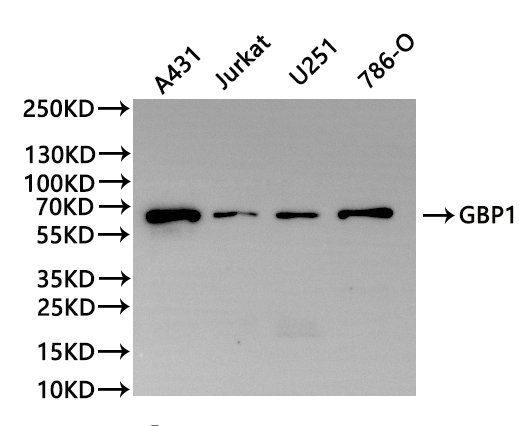
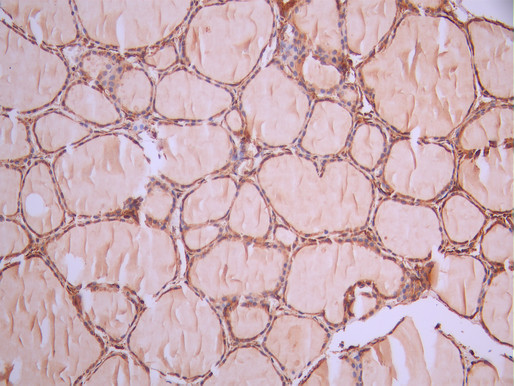
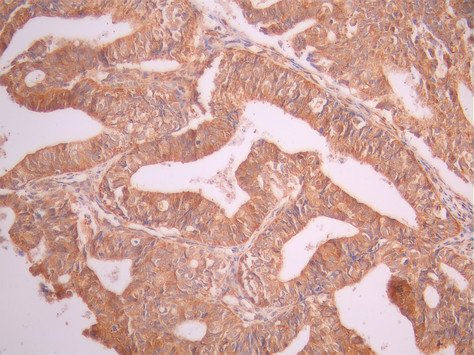
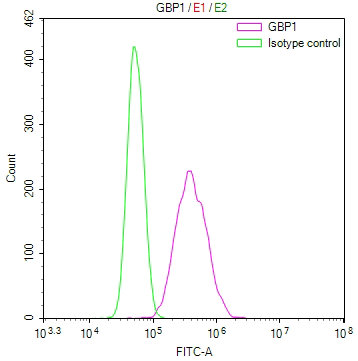
Validation data demonstrates robust performance across multiple applications. Western blot analysis confirms specific detection of GBP1 at the expected 68 kDa molecular weight across diverse human cell lines, including A431 epidermoid carcinoma, Jurkat T lymphocytes, U251 glioblastoma, and 786-O renal carcinoma cells, providing confidence when working with various cellular models. Immunohistochemistry staining has been successfully performed on paraffin-embedded human thyroid tissue and ovarian cancer specimens, revealing clear target localization suitable for tissue-based investigations. Flow cytometry validation using 786-O cells demonstrates effective intracellular detection with distinct population separation from isotype controls.
Whether investigating interferon signaling mechanisms, characterizing immune cell populations, or examining GBP1 expression patterns in disease contexts, this antibody provides a versatile tool for immunology research. The validated performance across western blotting, immunohistochemistry, flow cytometry, and ELISA applications supports integration into diverse experimental strategies.
There are currently no reviews for this product.





