
Call us
301-363-4651 (Available 9 a.m. to 5 p.m. CST from Monday to Friday)

| Code | CSB-RA446934A0HU |
| Size | US$210 |
| Order now | |
| Image |
|
| Have Questions? | Leave a Message or Start an on-line Chat |
| Application | Recommended Dilution |
|---|---|
| WB | 1:500-1:5000 |
| IHC | 1:50-1:200 |
| FC | 1:50-1:200 |
Glutaminase (GLS) serves as a critical enzyme in cellular metabolism, catalyzing the conversion of glutamine to glutamate in mitochondria. This metabolic pathway has garnered significant research attention due to its essential role in cancer cell proliferation, where rapidly dividing cells exhibit heightened glutamine dependency to support biosynthetic demands and energy production. Beyond oncology, GLS plays important roles in neuroscience research, particularly in understanding glutamatergic neurotransmission and related neurological processes.
This recombinant monoclonal antibody, clone 22B4, offers researchers the consistency and reproducibility that sequence-defined antibody production provides. Generated against a synthetic peptide from human GLS protein, the rabbit monoclonal format ensures lot-to-lot reliability for longitudinal studies and multi-site collaborations where experimental reproducibility is paramount.
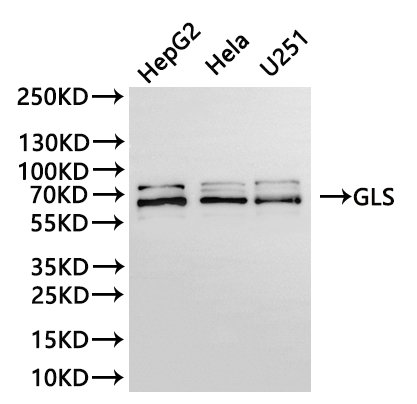
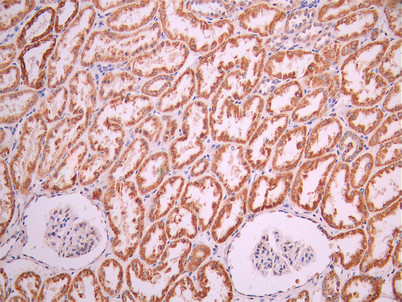
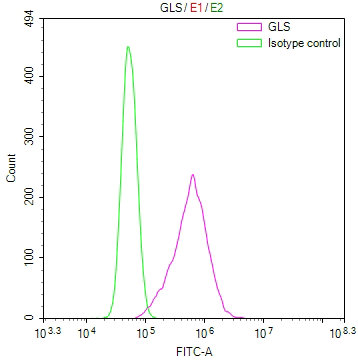
Validation across multiple applications demonstrates this antibody's versatility in diverse experimental workflows. Western blot analysis confirms specific detection in HepG2, HeLa, and U251 cell lysates, with observed bands at both 73 kDa matching the predicted molecular weight and an additional 62 kDa band, likely representing the glutaminase C isoform or post-translational processing variants known to occur with this enzyme. Immunohistochemistry validation in human kidney tissue, where GLS is abundantly expressed, shows clear staining patterns suitable for tissue-based studies. Flow cytometry analysis using 786-O renal carcinoma cells further extends the antibody's utility for single-cell quantification approaches.
The recommended working dilutions span from 1:500 to 1:5000 for western blotting and 1:50 to 1:200 for immunohistochemistry and flow cytometry, providing flexibility for optimization across different sample types. This antibody supports researchers investigating metabolic reprogramming, glutamine metabolism, and neuroscience applications where reliable GLS detection is essential.
There are currently no reviews for this product.





