
Call us
301-363-4651 (Available 9 a.m. to 5 p.m. CST from Monday to Friday)

| Code | CSB-RA083975A0HU |
| Size | US$210 |
| Order now | |
| Image |
|
| Have Questions? | Leave a Message or Start an on-line Chat |
| Application | Recommended Dilution |
|---|---|
| WB | 1:500-1:2000 |
| IHC | 1:50-1:200 |
| FC | 1:50-1:200 |
HSD17B10 is a multifunctional mitochondrial enzyme with remarkable biological significance, participating in steroid hormone metabolism, fatty acid oxidation, and isoleucine catabolism. Beyond these metabolic roles, this enzyme serves as an essential component of mitochondrial RNase P and has gained considerable attention for its interaction with amyloid beta-peptide, positioning it as a key target in neurodegeneration research, metabolic disorder studies, and cancer biology investigations.
This recombinant monoclonal antibody, generated against a synthetic peptide derived from human HSD17B10, offers the reproducibility and consistency that demanding research protocols require. As a sequence-defined reagent produced through recombinant technology, it eliminates the lot-to-lot variability that can compromise longitudinal studies and ensures reliable performance across your experimental timeline.
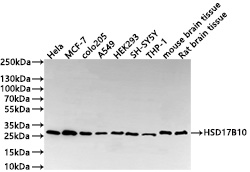
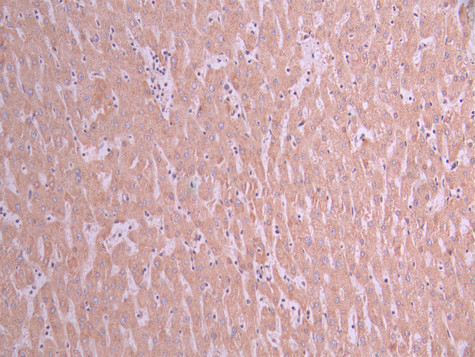
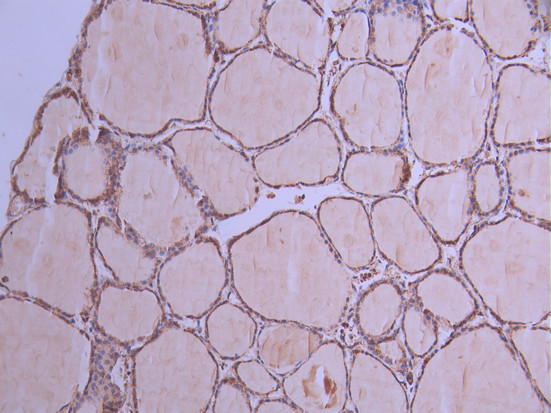
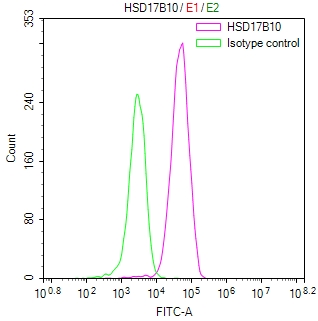
Extensive validation demonstrates this antibody's versatility across multiple applications. Western blot analysis confirms specific detection at the expected 27 kDa molecular weight across diverse human cell lines including HeLa, MCF-7, Colo205, A549, HEK293, SH-SY5Y, and THP-1 cells, with recommended dilutions ranging from 1:500 to 1:2000. Cross-species reactivity extends to mouse and rat samples, validated through detection in brain tissue lysates from both species, supporting translational research using rodent models. Immunohistochemistry applications have been validated in human liver cancer and thyroid tissue sections at 1:100 dilution, while flow cytometry analysis demonstrates clear positive staining in MCF-7 cells, enabling quantitative single-cell studies.
Whether investigating mitochondrial dysfunction in neurodegenerative disease models, exploring metabolic reprogramming in cancer, or characterizing steroid hormone pathways, this antibody provides a dependable tool for advancing your research across protein expression, tissue localization, and cellular analysis workflows.
There are currently no reviews for this product.





