

Call us
301-363-4651 (Available 9 a.m. to 5 p.m. CST from Monday to Friday)

| Code | CSB-RA957600A0HU |
| Size | US$210 |
| Order now | |
| Image |
|
| Have Questions? | Leave a Message or Start an on-line Chat |
| Application | Recommended Dilution |
|---|---|
| WB | 1:500-1:5000 |
| IHC | 1:50-1:200 |
HSPE1, commonly known as Hsp10 or chaperonin 10, serves as an essential mitochondrial co-chaperone that partners with Hsp60 to facilitate proper protein folding within the mitochondrial matrix. This 10 kDa heat shock protein plays critical roles in cellular stress responses, mitochondrial quality control, and has garnered significant attention for its identification as an early-pregnancy factor. Dysregulation of HSPE1 has been implicated in various pathological conditions, including cancer and neurodegenerative diseases, making it a valuable target for researchers investigating mitochondrial biology and cellular proteostasis.
This recombinant monoclonal antibody, clone 11D7, offers the reproducibility and consistency that demanding experimental workflows require. Generated against a synthesized peptide derived from human HSPE1, the recombinant format ensures sequence-defined specificity and eliminates the lot-to-lot variability that can compromise longitudinal studies or multi-site collaborations.
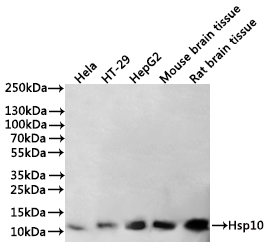
Validation studies demonstrate robust performance across multiple detection platforms. Western blot analysis confirms specific detection at the expected 11 kDa molecular weight across diverse sample types, including human cell lines such as HeLa, HT-29, and HepG2, with cross-species reactivity extending to mouse brain and rat kidney tissue lysates. For tissue-based investigations, immunohistochemistry protocols have been optimized in paraffin-embedded human specimens, with validated staining demonstrated in lung cancer and liver tissue sections using citrate buffer antigen retrieval at dilutions of 1:100.
Whether you are exploring mitochondrial chaperone networks, investigating stress response pathways in cancer models, or characterizing HSPE1 expression patterns across tissue types, this antibody provides a reliable tool for advancing your research into this fundamental component of cellular protein homeostasis.
There are currently no reviews for this product.





