
Call us
301-363-4651 (Available 9 a.m. to 5 p.m. CST from Monday to Friday)

| Code | CSB-RA616248A0HU |
| Size | US$210 |
| Order now | |
| Image |
|
| Have Questions? | Leave a Message or Start an on-line Chat |
| Application | Recommended Dilution |
|---|---|
| WB | 1:500-1:5000 |
| IHC | 1:50-1:200 |
HTR2C, also known as the serotonin 2C receptor, plays a central role in serotonergic neurotransmission and has been implicated in diverse physiological processes including mood regulation, appetite control, and energy homeostasis. This G protein-coupled receptor represents a significant target for researchers investigating neuropsychiatric disorders, metabolic dysfunction, and signal transduction pathways, making reliable detection tools essential for advancing our understanding of its expression and distribution.
This recombinant monoclonal antibody, clone 9H8, offers the consistency and reproducibility that demanding research applications require. Because it is produced from a defined genetic sequence rather than traditional hybridoma methods, researchers benefit from lot-to-lot uniformity that supports longitudinal studies and ensures experimental comparability across projects. The rabbit host origin and monoclonal nature provide excellent specificity for detecting human HTR2C.
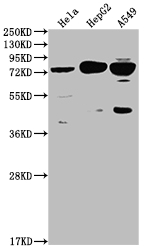
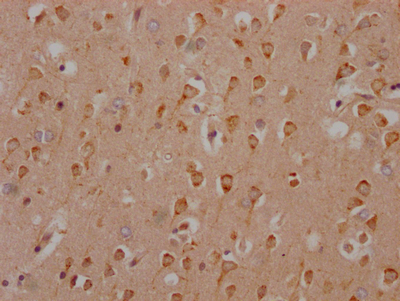
Validation studies demonstrate robust performance across multiple experimental platforms. In western blot applications, this antibody successfully detects HTR2C in HeLa, HepG2, and A549 whole cell lysates at dilutions ranging from 1:500 to 1:5000. The observed band at approximately 75 kDa, higher than the predicted molecular weights of 52 and 29 kDa, likely reflects post-translational modifications such as glycosylation, which is characteristic of membrane-bound receptors. For tissue-based studies, immunohistochemistry validation in paraffin-embedded human brain tissue at 1:100 dilution confirms reliable staining using standard antigen retrieval protocols.
Whether investigating serotonin receptor biology in neurological disease models, exploring metabolic signaling pathways, or characterizing receptor expression patterns in human tissues, this antibody provides researchers with a dependable tool for advancing their work in neuroscience, metabolism, and signal transduction research.
There are currently no reviews for this product.





