
Call us
301-363-4651 (Available 9 a.m. to 5 p.m. CST from Monday to Friday)

| Code | CSB-RA184907A0HU |
| Size | US$210 |
| Order now | |
| Image |
|
| Have Questions? | Leave a Message or Start an on-line Chat |
| Application | Recommended Dilution |
|---|---|
| WB | 1:500-1:2000 |
| IHC | 1:50-1:200 |
Interleukin-11 receptor subunit alpha (IL11RA) serves as the ligand-binding component of the IL-11 receptor complex, playing a central role in cytokine signaling pathways that regulate hematopoiesis, bone metabolism, and inflammatory responses. IL-11 signaling through this receptor has garnered significant research attention for its involvement in fibrotic diseases, cancer progression, and stem cell biology, making reliable detection of IL11RA essential for investigators studying these processes.
This recombinant monoclonal antibody, clone 6B2, offers the consistency and reproducibility that demanding experimental workflows require. Because the antibody sequence is defined and produced recombinantly in rabbit host cells, researchers benefit from lot-to-lot uniformity that eliminates the variability often encountered with traditional hybridoma-derived antibodies. This reliability is particularly valuable for longitudinal studies or when standardizing protocols across laboratory teams.
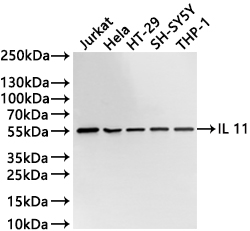
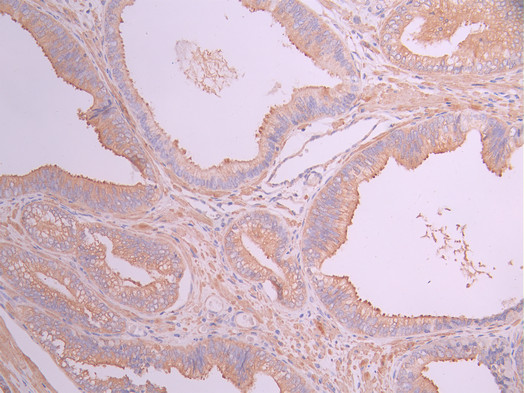
Validation testing demonstrates robust performance across multiple applications. In western blot analysis, the antibody detects IL11RA in a range of human cell lines including Jurkat, HeLa, HT-29, SH-SY5Y, and THP-1 whole cell lysates at dilutions between 1:500 and 1:2000. The observed band at approximately 55 kDa runs slightly higher than the predicted 45 kDa molecular weight, a shift consistent with post-translational glycosylation typical of membrane-associated receptor proteins. Immunohistochemistry validation in paraffin-embedded human prostate cancer tissue confirms suitability for tissue-based studies, with effective staining achieved at 1:50 to 1:200 dilutions following citrate buffer antigen retrieval.
This antibody supports researchers investigating IL-11 signaling in oncology, fibrosis, and inflammatory disease contexts, providing a dependable tool for characterizing receptor expression across cell culture and tissue specimens.
There are currently no reviews for this product.





