
Call us
301-363-4651 (Available 9 a.m. to 5 p.m. CST from Monday to Friday)

| Code | CSB-RA548303A0HU |
| Size | US$210 |
| Order now | |
| Image |
|
| Have Questions? | Leave a Message or Start an on-line Chat |
| Application | Recommended Dilution |
|---|---|
| IHC | 1:50-1:200 |
Integrin alpha-V (ITGAV/CD51) serves as a critical adhesion receptor that mediates cell-extracellular matrix interactions across diverse biological contexts. As the alpha subunit of multiple integrin heterodimers, ITGAV participates in angiogenesis, tumor cell migration, and metastatic progression, making it a compelling target for researchers investigating cancer biology, cardiovascular function, and stem cell behavior. Its role in pathogen entry mechanisms also positions ITGAV as a relevant target in microbiology studies.
This recombinant monoclonal antibody, clone 4G7, offers the reproducibility and consistency that demanding experimental workflows require. Generated against a synthetic peptide derived from human Integrin alpha-V and produced using recombinant technology in rabbit host, this antibody provides sequence-defined specificity that eliminates the lot-to-lot variability often encountered with traditional hybridoma-derived reagents. The result is reliable performance across extended studies and multi-site collaborations where experimental consistency is paramount.
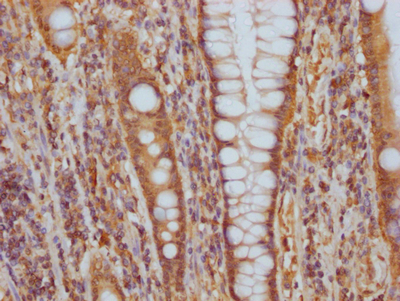
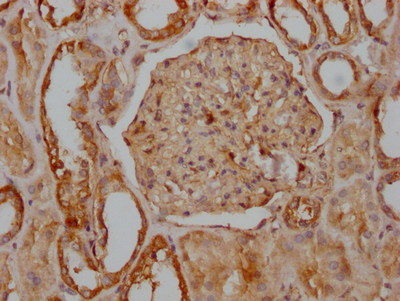
Validation through immunohistochemistry demonstrates robust detection in formalin-fixed, paraffin-embedded human tissues. Testing in human colon cancer tissue and human kidney sections at 1:100 dilution using citrate buffer antigen retrieval confirms the antibody's utility for examining ITGAV expression patterns in both neoplastic and normal tissue contexts. Researchers can optimize working concentrations within the 1:50-1:200 range depending on tissue type and detection system sensitivity. The antibody is additionally validated for ELISA applications, providing flexibility for quantitative studies.
Supplied in a glycerol-containing buffer optimized for long-term stability, this affinity-purified antibody supports investigations into integrin-mediated signaling, tumor microenvironment interactions, and cellular adhesion mechanisms central to understanding disease progression and therapeutic targeting strategies.
There are currently no reviews for this product.





