
Call us
301-363-4651 (Available 9 a.m. to 5 p.m. CST from Monday to Friday)

| Code | CSB-RA194949A0HU |
| Size | US$210 |
| Order now | |
| Image |
|
| Have Questions? | Leave a Message or Start an on-line Chat |
| Application | Recommended Dilution |
|---|---|
| WB | 1:500-1:5000 |
| IHC | 1:50-1:200 |
| IF | 1:20-1:200 |
| IP | 1:200-1:1000 |
KLF4, or Krüppel-like factor 4, serves as a critical zinc finger transcription factor that orchestrates cellular fate decisions across diverse biological contexts. As a core component of the Yamanaka factors essential for induced pluripotent stem cell generation, KLF4 has become indispensable in stem cell research and regenerative medicine studies. Beyond pluripotency, this transcription factor plays complex roles in cancer biology, where it can function as either a tumor suppressor or oncogene depending on tissue context, making it a compelling target for oncology research.
This recombinant monoclonal antibody, generated against a synthetic peptide derived from human KLF4, offers the reproducibility that demanding experimental workflows require. As a sequence-defined recombinant clone, it eliminates the lot-to-lot variability that can compromise longitudinal studies or multi-site collaborations, ensuring your results remain consistent across experiments.
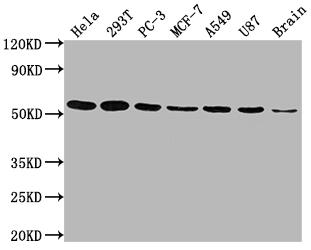
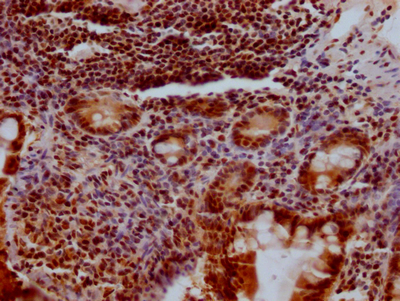
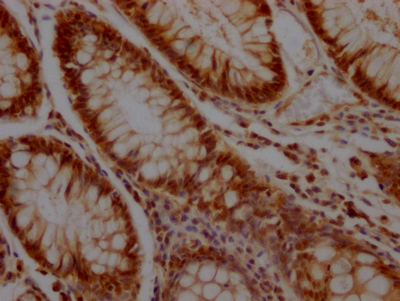
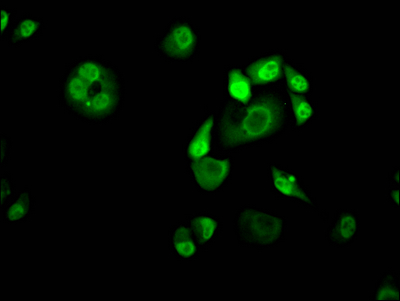
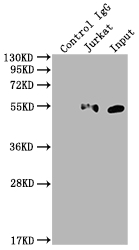
Validation data demonstrates robust performance across multiple applications. Western blot analysis detects a clear band at the expected 55 kDa molecular weight across an impressive range of human cell lines including HeLa, 293T, PC-3, MCF-7, A549, and U87, as well as brain tissue, confirming reliable detection in both cultured cells and primary tissue samples. Immunohistochemistry staining has been validated in human small intestine and colon cancer tissue sections, while immunofluorescence studies in HeLa cells reveal the expected nuclear localization pattern consistent with KLF4's function as a transcription factor. Immunoprecipitation capability has also been confirmed in HeLa lysates, enabling protein interaction studies.
This antibody supports investigations spanning epigenetics, cardiovascular biology, developmental processes, and cancer research where understanding KLF4's regulatory functions remains an active area of discovery.
There are currently no reviews for this product.





