
Call us
301-363-4651 (Available 9 a.m. to 5 p.m. CST from Monday to Friday)

| Code | CSB-RA012882MA1HU |
| Size | US$210 |
| Order now | |
| Image |
|
| Have Questions? | Leave a Message or Start an on-line Chat |
| Application | Recommended Dilution |
|---|---|
| FC | 1:20-1:500 |
Galectin-1, encoded by the LGALS1 gene, is a beta-galactoside-binding lectin that plays multifaceted roles in cellular homeostasis, immune regulation, and tumor biology. This 14 kDa protein modulates cell-cell and cell-matrix interactions, influences T cell apoptosis, and has emerged as a significant factor in tumor immune evasion and angiogenesis. Its involvement in both physiological and pathological processes makes it a compelling target for researchers investigating cancer progression, immune modulation, and cell signaling pathways.
This recombinant monoclonal antibody, clone 5G8, offers the reproducibility and consistency that demanding experimental workflows require. Produced using recombinant technology with a sequence-defined approach, it eliminates the lot-to-lot variability that can compromise longitudinal studies or multi-site collaborations. The mouse IgG2a isotype antibody was raised against recombinant human LGALS1 protein and has been validated for human sample reactivity, providing confidence when working with human-derived specimens.
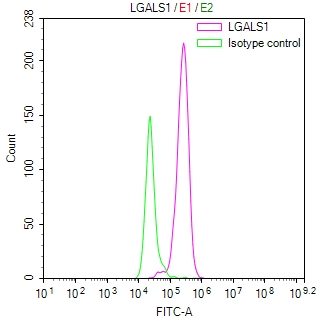
Flow cytometry validation demonstrates robust performance, with clear positive signal detection in 3T3 cells when used at dilutions ranging from 1:20 to 1:500. The validation protocol employed fixed and permeabilized cells, confirming the antibody's utility for intracellular detection of galectin-1. This flexibility in working dilution allows researchers to optimize conditions for their specific experimental systems while maintaining reliable detection.
Supplied in a glycerol-based PBS buffer for stability, this affinity-purified antibody is well-suited for researchers exploring galectin-1's contributions to tumor microenvironment dynamics, immune cell function, and MAPK signaling pathways. Its validated performance in ELISA and flow cytometry applications supports diverse experimental approaches in cancer biology and cell signaling research.
There are currently no reviews for this product.





