
Call us
301-363-4651 (Available 9 a.m. to 5 p.m. CST from Monday to Friday)

| Code | CSB-RA984483A0HU |
| Size | US$210 |
| Order now | |
| Image |
|
| Have Questions? | Leave a Message or Start an on-line Chat |
| Application | Recommended Dilution |
|---|---|
| IHC | 1:50-1:200 |
| FC | 1:50-1:200 |
Ki-67, encoded by the MKI67 gene, serves as one of the most widely used markers for cellular proliferation in both research and clinical settings. This nuclear protein is expressed during all active phases of the cell cycle but remains absent in quiescent cells, making it an invaluable tool for assessing growth fractions in tumor samples and understanding proliferative dynamics in normal tissues. Its utility spans cancer research, where Ki-67 labeling indices inform prognosis and treatment decisions, as well as neuroscience and cell biology studies examining tissue homeostasis and regeneration.
This recombinant monoclonal antibody, generated against a synthetic peptide derived from human Ki-67, offers the reproducibility that demanding quantitative studies require. Because the antibody sequence is defined and production occurs through recombinant expression rather than hybridoma culture, researchers can expect consistent performance across experiments and over time, eliminating the lot-to-lot variability that can confound longitudinal studies or multi-site collaborations.
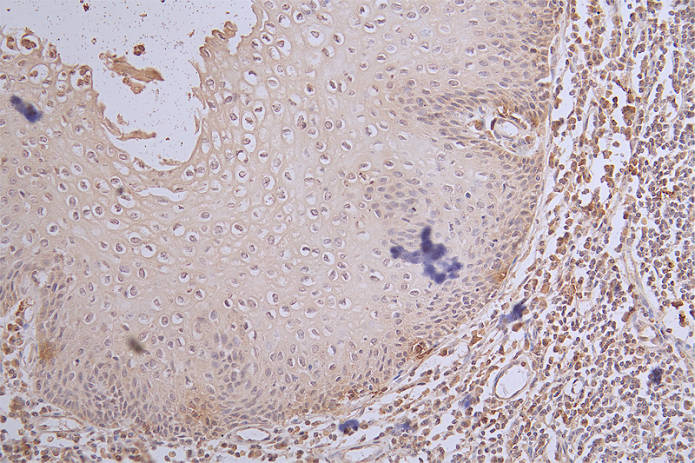
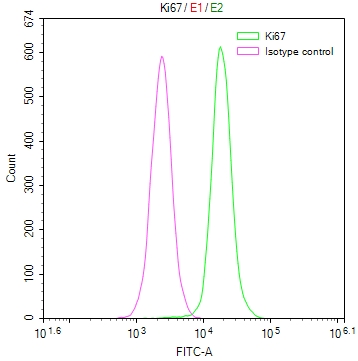
Validation in immunohistochemistry demonstrates clear nuclear staining in paraffin-embedded human tonsil tissue, a tissue rich in proliferating lymphocytes that serves as an ideal positive control. The antibody performs effectively at dilutions between 1:50 and 1:200 using standard citrate-based antigen retrieval on automated staining platforms. Flow cytometry validation using HeLa cells confirms reliable detection of intracellular Ki-67 following formaldehyde fixation and Triton X-100 permeabilization, with distinct separation from isotype control signals.
Whether quantifying proliferative indices in tumor specimens, characterizing cell cycle dynamics in culture, or investigating tissue regeneration, this antibody provides a dependable tool for researchers studying human samples across oncology, neuroscience, and fundamental cell biology applications.
There are currently no reviews for this product.





