
Call us
301-363-4651 (Available 9 a.m. to 5 p.m. CST from Monday to Friday)

| Code | CSB-RA037177A0HU |
| Size | US$210 |
| Order now | |
| Image |
|
| Have Questions? | Leave a Message or Start an on-line Chat |
| Application | Recommended Dilution |
|---|---|
| WB | 1:500-1:2000 |
| FC | 1:50-1:200 |
NUDT1, also known as MTH1, serves as a critical guardian of genomic integrity by hydrolyzing oxidized nucleotide triphosphates such as 8-oxo-dGTP, preventing their misincorporation into DNA during replication. This sanitization function has garnered significant research attention, particularly in cancer biology, where NUDT1 overexpression in tumor cells may represent an adaptive response to elevated oxidative stress. Understanding NUDT1 expression and function provides valuable insights into DNA damage response pathways and potential therapeutic vulnerabilities in malignant cells.
This recombinant monoclonal antibody, clone 8B10, offers researchers the reproducibility essential for longitudinal studies and cross-laboratory comparisons. Generated from a defined sequence against a synthetic peptide derived from human NUDT1, the antibody delivers consistent performance across experiments, eliminating the lot-to-lot variability that can complicate data interpretation with traditional hybridoma-derived reagents.
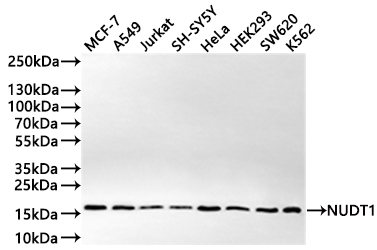
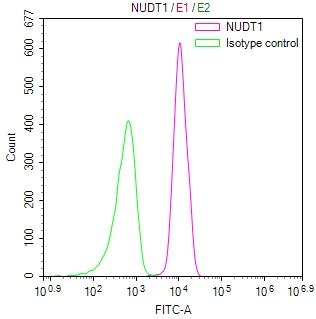
Validation studies demonstrate robust detection of NUDT1 across a diverse panel of human cell lines in Western blot applications, including MCF-7, A549, Jurkat, SH-SY5Y, HeLa, HEK293, SW620, and K562 lysates. The antibody produces a clean band at the predicted molecular weight of 18 kDa, confirming specific target recognition. Flow cytometry validation in Jurkat cells further establishes utility for single-cell analysis of intracellular NUDT1 levels, with clear separation between specific staining and isotype control populations.
The antibody's compatibility with Western blotting, flow cytometry, and ELISA provides workflow flexibility for researchers investigating oxidative stress responses, DNA repair mechanisms, and cancer cell metabolism. Whether profiling NUDT1 expression across tumor models or examining its regulation under genotoxic conditions, this reagent supports rigorous, reproducible experimental approaches.
There are currently no reviews for this product.





