
Call us
301-363-4651 (Available 9 a.m. to 5 p.m. CST from Monday to Friday)

| Code | CSB-RA618759MA1HU |
| Size | US$210 |
| Order now | |
| Image |
|
| Have Questions? | Leave a Message or Start an on-line Chat |
| Application | Recommended Dilution |
|---|---|
| FC | 1:50-1:200 |
PRKAA1, the catalytic alpha-1 subunit of AMP-activated protein kinase, serves as a central regulator of cellular energy homeostasis. This master metabolic sensor responds to changes in the AMP:ATP ratio, orchestrating downstream signaling cascades that control lipid metabolism, glucose uptake, and autophagy. Through its kinase activity toward substrates including acetyl-CoA carboxylase and HMG-CoA reductase, PRKAA1 influences critical metabolic pathways, making it an essential target for research into metabolic disorders, diabetes, cancer metabolism, and cardiovascular disease.
This recombinant monoclonal antibody, clone 22B10, offers researchers the reproducibility and consistency that recombinant technology provides. Generated against recombinant human PRKAA1 protein and expressed with a human IgG1 framework, this antibody delivers sequence-defined specificity that eliminates the lot-to-lot variability often encountered with traditional hybridoma-derived reagents. The affinity-chromatography purification ensures high purity for demanding experimental workflows.
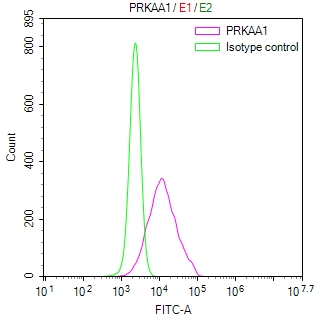
Validation studies demonstrate effective performance in flow cytometry applications using HeLa cells. Testing with fixed and permeabilized cells at 1:100 dilution showed clear signal separation from isotype control, confirming specific intracellular detection of PRKAA1. The antibody has been validated for ELISA and flow cytometry, with recommended dilutions of 1:50-1:200 for flow cytometry applications, providing flexibility for optimization across different experimental conditions.
For investigators studying AMPK signaling in metabolic regulation, cellular stress responses, or energy-sensing pathways, this antibody provides a reliable tool for detecting human PRKAA1. Its validated performance in flow cytometry makes it particularly suitable for quantitative analysis of AMPK expression across cell populations in metabolic and oncology research contexts.
There are currently no reviews for this product.





