
Call us
301-363-4651 (Available 9 a.m. to 5 p.m. CST from Monday to Friday)

| Code | CSB-RA275990A0HU |
| Size | US$210 |
| Order now | |
| Image |
|
| Have Questions? | Leave a Message or Start an on-line Chat |
| Application | Recommended Dilution |
|---|---|
| WB | 1:500-1:5000 |
| IHC | 1:50-1:200 |
| FC | 1:50-1:200 |
PSIP1, also known as LEDGF (Lens Epithelium-Derived Growth Factor) or DFS70, serves as a critical transcriptional coactivator involved in chromatin binding, stress response, and DNA repair pathways. This protein has garnered significant research attention due to its role as a cofactor for HIV integrase, making it a key target in retroviral integration studies. Additionally, PSIP1 has emerged as a clinically relevant autoantigen, with anti-DFS70 antibodies serving as important biomarkers in autoimmune disease diagnostics.
This recombinant rabbit monoclonal antibody (clone 5H8) offers the reproducibility and consistency that demanding research applications require. Generated against a synthetic peptide derived from human PSIP1, the recombinant format ensures sequence-defined specificity and eliminates the lot-to-lot variability that can compromise longitudinal studies or multi-site collaborations.
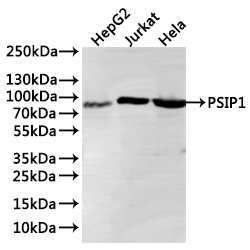
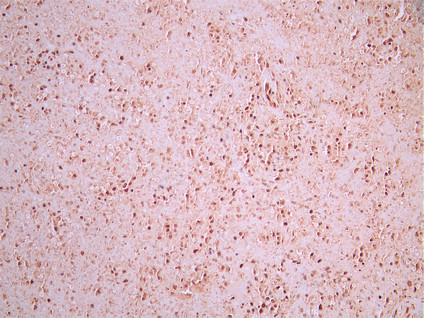
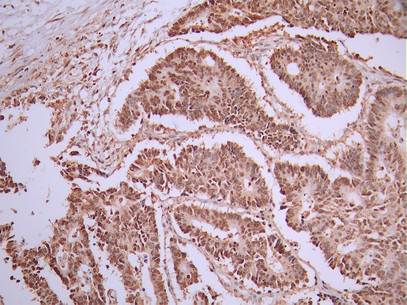
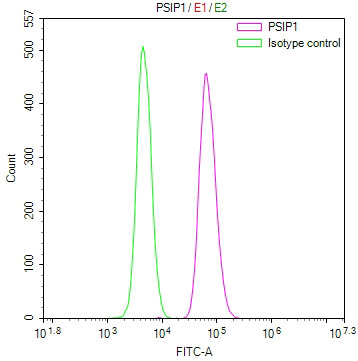
Validation across multiple platforms demonstrates this antibody's versatility in your experimental workflows. Western blot analysis confirms robust detection in human cell lines including HepG2, Jurkat, and HeLa lysates, with an observed band at approximately 75 kDa. This size difference from the predicted 60 kDa molecular weight likely reflects post-translational modifications, particularly glycosylation, characteristic of the native protein. Immunohistochemistry validation in human spleen tissue and colorectal cancer specimens shows clear staining using citrate buffer antigen retrieval, while flow cytometry analysis in SH-SY5Y neuroblastoma cells confirms utility for single-cell detection approaches.
Whether investigating LEDGF's role in HIV integration, exploring its function in transcriptional regulation, or examining its significance as an autoimmune target, this antibody provides a reliable tool for advancing your PSIP1 research across immunoblotting, tissue-based, and cytometric applications.
There are currently no reviews for this product.





