
Call us
301-363-4651 (Available 9 a.m. to 5 p.m. CST from Monday to Friday)

| Code | CSB-RA886270A0HU |
| Size | US$210 |
| Order now | |
| Image |
|
| Have Questions? | Leave a Message or Start an on-line Chat |
| Application | Recommended Dilution |
|---|---|
| WB | 1:500-1:5000 |
| IHC | 1:50-1:200 |
| IF | 1:50-1:200 |
| FC | 1:50-1:200 |
PSMD14, also known as POH1 or RPN11, serves as an essential deubiquitinating enzyme within the 19S regulatory particle of the 26S proteasome. This metalloprotease cleaves ubiquitin chains from substrates prior to their degradation, making it a critical regulator of protein homeostasis. Beyond its canonical proteasomal function, PSMD14 has emerged as a significant player in DNA damage repair, cell cycle progression, and has been implicated in various malignancies, positioning it as a valuable target for researchers investigating proteostasis and cancer biology.
This recombinant monoclonal antibody, generated from a defined rabbit clone (25G9) against a synthetic peptide derived from human PSMD14, offers the reproducibility and consistency that demanding experimental workflows require. Because the antibody sequence is fixed, researchers can expect uniform performance across different lots, eliminating a common source of experimental variability that can complicate long-term studies.
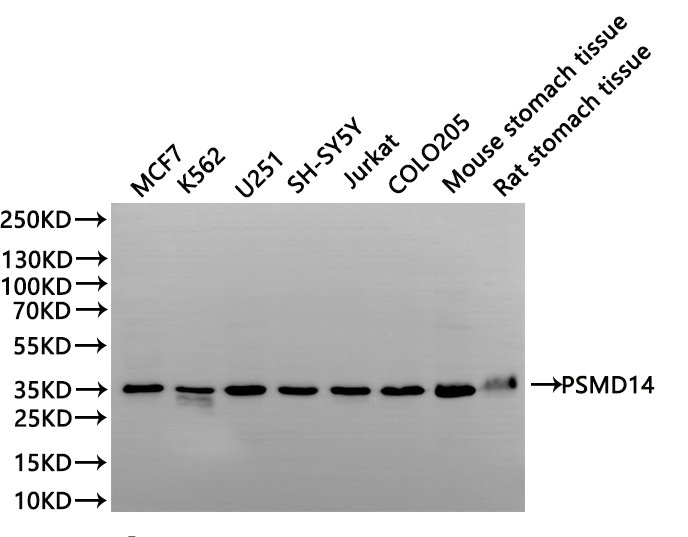
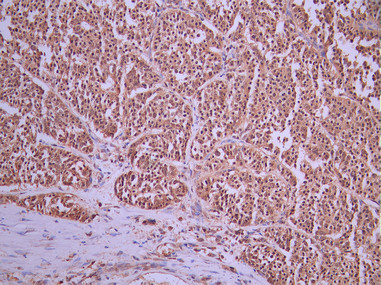
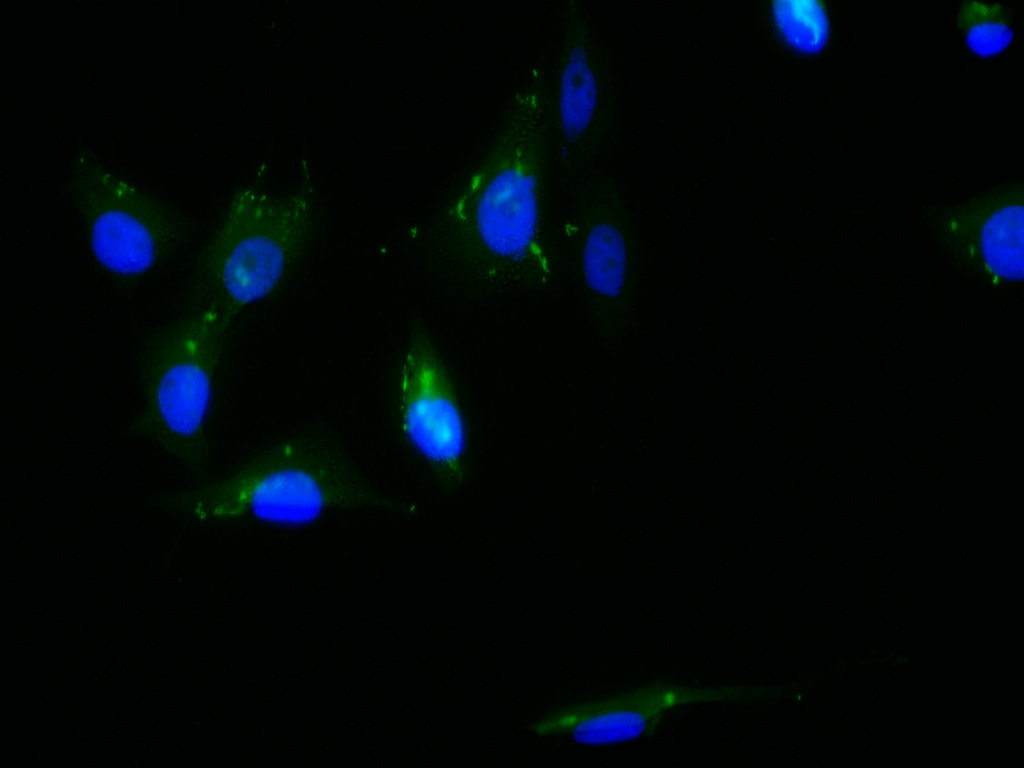
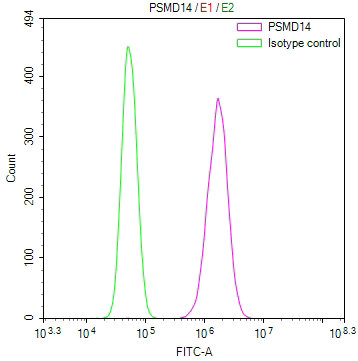
Validation data demonstrates robust performance across multiple applications. Western blot analysis detects a clean 35 kDa band matching the predicted molecular weight across diverse human cell lines including MCF7, K562, U251, SH-SY5Y, Jurkat, and COLO205, with cross-species reactivity confirmed in mouse and rat stomach tissue lysates. Immunohistochemistry staining has been optimized in human liver cancer tissue sections, while immunofluorescence studies in PC-3 cells reveal the expected subcellular localization pattern. Flow cytometry validation in 786-O cells further extends the application flexibility available to researchers.
Whether investigating proteasome function, exploring ubiquitin-dependent pathways, or examining PSMD14's emerging roles in oncogenesis, this antibody provides a reliable tool for cell biology research across multiple experimental platforms.
There are currently no reviews for this product.





