
Call us
301-363-4651 (Available 9 a.m. to 5 p.m. CST from Monday to Friday)

| Code | CSB-RA013456A204phHU |
| Size | US$210 |
| Order now | |
| Image |
|
| Have Questions? | Leave a Message or Start an on-line Chat |
| Application | Recommended Dilution |
|---|---|
| WB | 1:500-1:5000 |
The MAPK3/MAPK1 signaling cascade, commonly known as the ERK1/2 pathway, serves as a critical convergence point for extracellular signals that regulate cell proliferation, differentiation, and survival. Phosphorylation at the activation loop residues—T202/Y204 on MAPK3 (ERK1) and T185/Y187 on MAPK1 (ERK2)—represents the definitive marker of pathway activation, making detection of these phosphorylated forms essential for researchers investigating signal transduction dynamics in contexts ranging from growth factor signaling to neurological disease mechanisms.
This recombinant monoclonal antibody (clone 4F6) provides reliable detection of dual-phosphorylated ERK1/2 with the consistency that demanding phospho-protein studies require. Because the antibody is produced from a defined sequence in a recombinant system, you can expect uniform performance across experiments and over time—an important consideration when tracking subtle changes in phosphorylation status across treatment conditions or longitudinal studies.
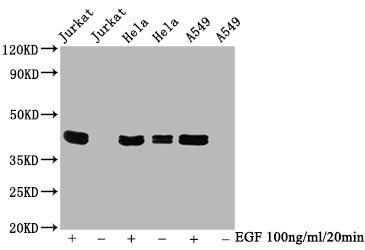
Western blot validation demonstrates robust detection in human cell lysates from Jurkat, HeLa, and A549 lines, with the A549 model tested both with and without EGF stimulation to confirm specificity for the activated kinase forms. The observed band at 42 kDa aligns precisely with the predicted molecular weight, indicating clean target recognition without confounding post-translational modifications or degradation products. The recommended working dilution range of 1:500 to 1:5000 offers flexibility to optimize signal-to-background ratio across different sample preparations and detection systems.
For researchers in neuroscience and related fields studying MAPK-dependent processes such as synaptic plasticity, neuronal survival signaling, or pathway dysregulation in disease states, this antibody delivers the phospho-specific detection needed to capture pathway activation with confidence.
There are currently no reviews for this product.





