
Call us
301-363-4651 (Available 9 a.m. to 5 p.m. CST from Monday to Friday)

| Code | CSB-RA859108A463phHU |
| Size | US$210 |
| Order now | |
| Image |
|
| Have Questions? | Leave a Message or Start an on-line Chat |
| Application | Recommended Dilution |
|---|---|
| IHC | 1:50-1:200 |
SMAD5 serves as a critical intracellular mediator of bone morphogenetic protein signaling, translating extracellular BMP cues into transcriptional responses that govern cell fate decisions, differentiation, and tissue homeostasis. Phosphorylation at the C-terminal serine residues S463 and S465 represents the activating modification that enables SMAD5 to translocate to the nucleus and regulate target gene expression. Detecting this specific phosphorylation event allows researchers to monitor active BMP signaling in real time, making it essential for studies in developmental biology, stem cell research, and disease contexts where BMP pathway dysregulation plays a role.
This recombinant monoclonal antibody, generated in rabbit and designated clone 2G11, offers the reproducibility and consistency that phospho-specific detection demands. Because recombinant antibodies are produced from defined sequences rather than hybridoma-derived sources, researchers can expect uniform performance across experiments and over time, eliminating the lot-to-lot variability that can compromise longitudinal studies or multi-site collaborations. The antibody was raised against a synthetic phosphopeptide corresponding to the human Phospho-SMAD5 sequence surrounding S463 and S465, ensuring precise recognition of the activated form.
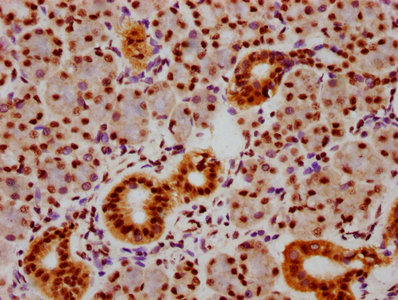
Validation in immunohistochemistry demonstrates reliable performance in paraffin-embedded human pancreatic tissue at dilutions ranging from 1:50 to 1:200, with optimized staining achieved using citrate buffer antigen retrieval at pH 6.0. This makes the antibody well-suited for researchers investigating BMP pathway activation in archival tissue samples or clinical specimens. Additional compatibility with ELISA extends its utility for quantitative applications.
For investigators exploring signal transduction mechanisms, particularly those examining how BMP signaling influences cellular responses in normal physiology and disease states, this antibody provides a dependable tool for tracking pathway activation at the level of SMAD5 phosphorylation.
There are currently no reviews for this product.





