
Call us
301-363-4651 (Available 9 a.m. to 5 p.m. CST from Monday to Friday)

| Code | CSB-RA859108A465phHU |
| Size | US$210 |
| Order now | |
| Image |
|
| Have Questions? | Leave a Message or Start an on-line Chat |
| Application | Recommended Dilution |
|---|---|
| WB | 1:500-1:5000 |
SMAD5 serves as a critical intracellular signal transducer in the bone morphogenetic protein (BMP) signaling pathway, playing essential roles in embryonic development, bone formation, and cellular differentiation. Phosphorylation at serine residues 463 and 465 represents the key activation event that enables SMAD5 to translocate to the nucleus and regulate target gene transcription. Detecting this specific phosphorylation state allows researchers to monitor active BMP signaling in real time, making phospho-specific antibodies indispensable tools for dissecting this pathway.
This recombinant monoclonal antibody, generated against a synthetic phosphopeptide encompassing the S463/S465 region of human SMAD5, offers the reproducibility and consistency that phospho-specific detection demands. Because recombinant antibodies are produced from defined sequences rather than traditional hybridoma methods, you can expect uniform performance across experiments and between lots, which is particularly valuable when tracking subtle changes in phosphorylation dynamics over time or across treatment conditions.
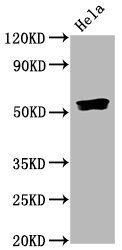
Validation in western blot applications demonstrates reliable detection in HeLa whole cell lysates, with the antibody recognizing a band at the predicted molecular weight of 52 kDa. This clean detection at the expected size confirms specificity for the target protein. The recommended working dilution range of 1:500 to 1:5000 provides flexibility to optimize signal intensity based on your sample type and expression levels.
Whether you are investigating BMP-mediated differentiation programs, studying developmental signaling cascades, or exploring SMAD5 activation in disease contexts, this phospho-specific antibody provides a dependable tool for monitoring pathway activity in human samples through western blotting and ELISA-based approaches.
There are currently no reviews for this product.





