
Call us
301-363-4651 (Available 9 a.m. to 5 p.m. CST from Monday to Friday)

| Code | CSB-RA921465A0HU |
| Size | US$210 |
| Order now | |
| Image |
|
| Have Questions? | Leave a Message or Start an on-line Chat |
| Application | Recommended Dilution |
|---|---|
| WB | 1:500-1:5000 |
| IHC | 1:50-1:200 |
| IF | 1:50-1:200 |
| FC | 1:50-1:200 |
SRP19 (Signal Recognition Particle 19 kDa protein) serves as an essential component of the signal recognition particle complex, playing a fundamental role in co-translational protein targeting to the endoplasmic reticulum. This process is critical for the proper localization and secretion of membrane and secretory proteins, making SRP19 a valuable target for researchers investigating protein trafficking, cellular stress responses, and signal transduction pathways.
This recombinant monoclonal antibody, generated from clone 25A9, offers the reproducibility and consistency that demanding research applications require. As a sequence-defined reagent produced through recombinant technology, it eliminates the lot-to-lot variability often encountered with traditional hybridoma-derived antibodies, ensuring your experimental results remain comparable across extended studies.
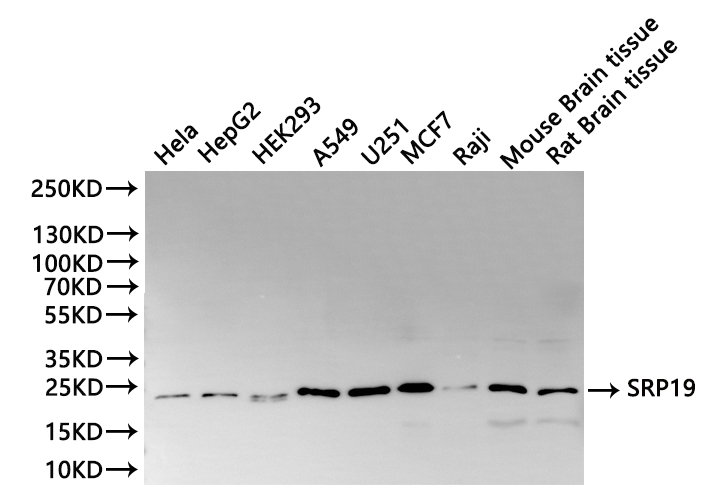
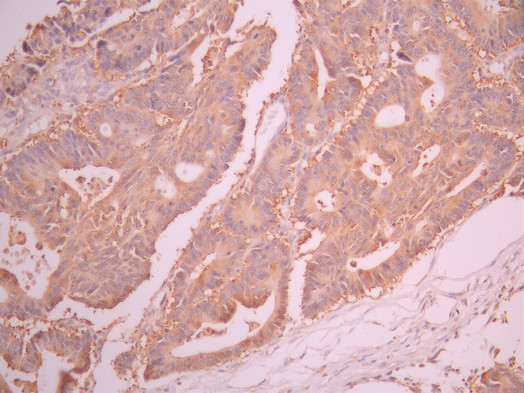
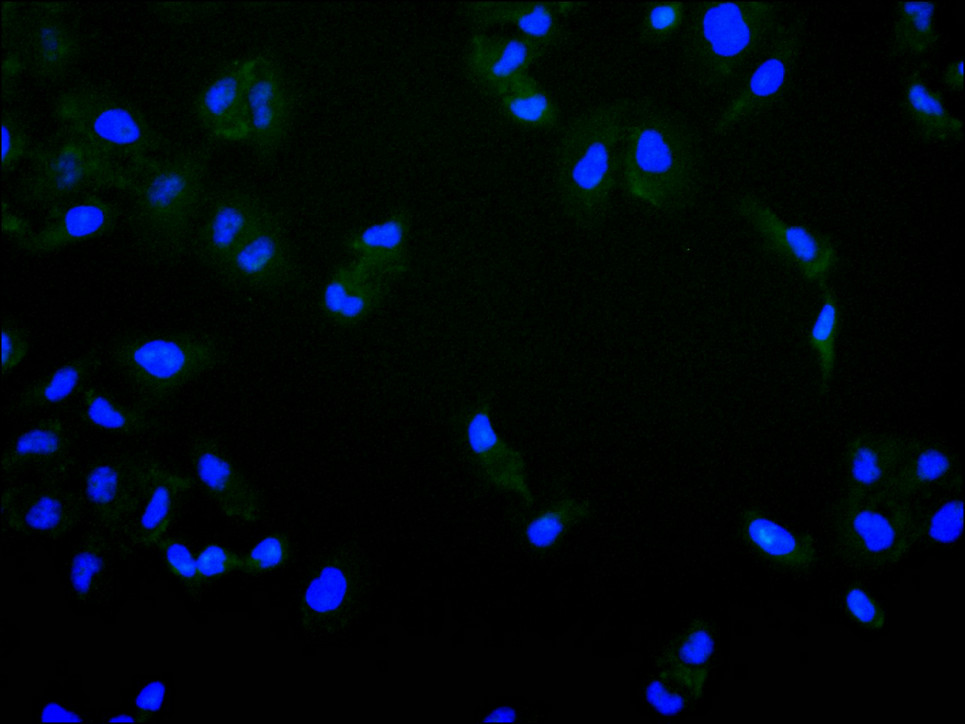
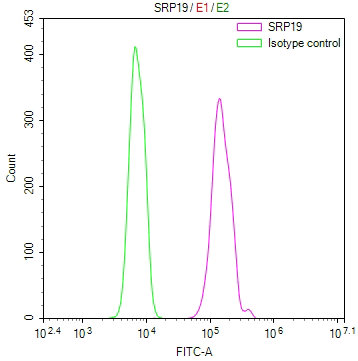
Extensive validation demonstrates robust performance across multiple experimental platforms. Western blot analysis confirms reliable detection in a diverse panel of human cell lines including HeLa, HepG2, HEK293, A549, U-251MG, MCF-7, and Raji cells, with cross-species reactivity verified in mouse and rat brain tissue lysates. The observed band size of approximately 20 kDa, slightly higher than the predicted 16 kDa molecular weight, likely reflects post-translational modifications such as glycosylation. Immunohistochemistry validation in human colorectal cancer tissue sections shows clear staining patterns, while immunofluorescence studies in HeLa cells reveal the expected subcellular distribution. Flow cytometry analysis further confirms specific detection with clear separation from isotype control.
This versatile antibody supports researchers studying signal transduction mechanisms, protein biosynthesis, and cellular trafficking processes, providing a dependable tool for both basic research and disease-related investigations where SRP pathway function may be implicated.
There are currently no reviews for this product.





