TM4SF1 Recombinant Monoclonal Antibody

Code CSB-RA023615MA1HU
Size US$210
Order now
Image
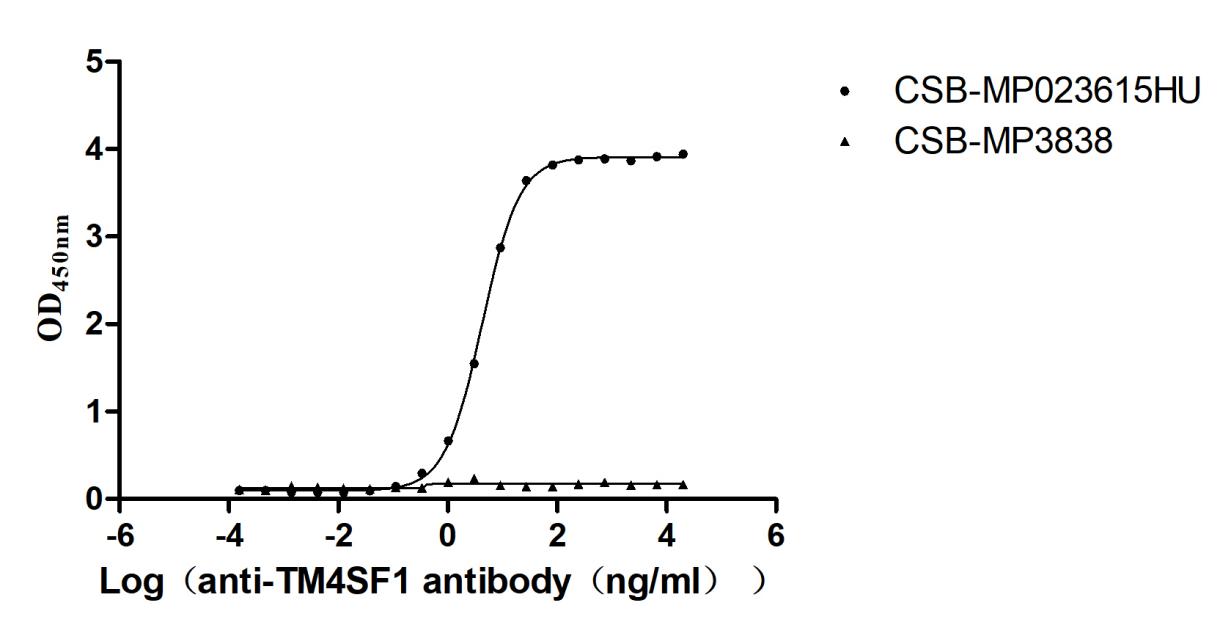
  • The Binding Activity of Human TM4SF1 with Anti-TM4SF1 recombinant antibody
    Activity: Measured by its binding ability in a functional ELISA. Immobilized Human TM4SF1(CSB-MP023615HU) at 5 μg/mL can bind Anti-TM4SF1 recombinant antibody. the EC50 is 4.079-4.472 ng/mL.
    The VLPs (CSB-MP3838) is negative control.
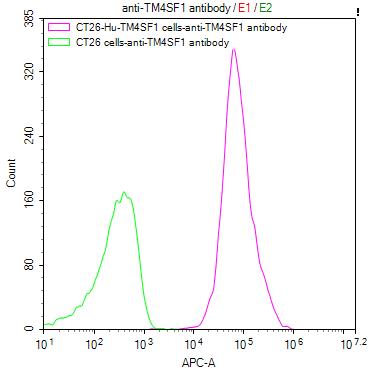
  • Untransfected CT26 cells (green line) and transfected Human TM4SF1*106cells), washed and then followed by APC-conjugated anti-Human IgG Fc antibody and analyzed with flow cytometry.
Have Questions? Leave a Message or Start an on-line Chat

Product Details

Uniprot No.
Target Names
Alternative Names
M3S1 antibody; Membrane component chromosome 3 surface marker 1 antibody; T4S1_HUMAN antibody; TAAL6 antibody; Tm4sf1 antibody; Transmembrane 4 L6 family member 1 antibody; Tumor-associated antigen L6 antibody
Species Reactivity
Human
Immunogen
Recombinant Human TM4SF1 protein
Immunogen Species
Homo sapiens (Human)
Conjugate
Non-conjugated
Clonality
Monoclonal
Isotype
hIgG1
Clone No.
6B3
Purification Method
Affinity-chromatography
Concentration
It differs from different batches. Please contact us to confirm it.
Buffer
Preservative: 0.03% Proclin 300
Constituents: 50% Glycerol, 0.01M PBS, PH 7.4
Form
Liquid
Tested Applications
ELISA, FC
Recommended Dilution
Application Recommended Dilution
FC 1:20-1:200
Troubleshooting and FAQs
Storage
Upon receipt, store at -20°C or -80°C. Avoid repeated freeze.
Lead Time
Basically, we can dispatch the products out in 1-3 working days after receiving your orders. Delivery time maybe differs from different purchasing way or location, please kindly consult your local distributors for specific delivery time.
Description

TM4SF1, also known as tumor-associated antigen L6, is a transmembrane protein belonging to the tetraspanin-like L6 superfamily. This cell surface marker has garnered significant research attention due to its elevated expression in various carcinomas and its functional roles in tumor progression, angiogenesis, and metastasis. TM4SF1 participates in organizing membrane microdomains that regulate cell migration and invasion, making it a compelling target for cancer biology research and potential therapeutic development.

This recombinant monoclonal antibody, clone 6B3, offers researchers the consistency and reliability that comes with sequence-defined production. Unlike traditional hybridoma-derived antibodies, recombinant technology ensures lot-to-lot reproducibility, allowing you to maintain experimental continuity across long-term studies without concerns about performance drift between batches.

Validation studies demonstrate robust performance in both ELISA and flow cytometry applications. Functional ELISA testing shows strong binding activity to immobilized human TM4SF1 protein, with EC50 values in the 4.079–4.472 ng/mL range, indicating high-affinity target recognition. Flow cytometry validation using transfected CT26 cells expressing human TM4SF1 confirms the antibody's ability to detect cell surface antigen, with untransfected cells serving as negative controls to verify specificity. For flow cytometry experiments, dilutions ranging from 1:20 to 1:200 provide flexibility to optimize signal intensity based on your specific experimental conditions.

Supplied as a purified liquid formulation in PBS with glycerol for stability, this antibody is well-suited for researchers investigating TM4SF1 biology in oncology, tumor microenvironment studies, and cell surface marker characterization in human samples.

Usage
For Research Use Only. Not for use in diagnostic or therapeutic procedures.

Customer Reviews and Q&A

 Customer Reviews

There are currently no reviews for this product.

Submit a Review here

Target Background

Gene References into Functions
  1. our study provides a novel regulatory pathway involving TM4SF1, DDR1, MMP2 and MMP9, which promotes the formation and function of invadopodia to support cell migration and invasion in pancreatic cancer. PMID: 28368050
  2. Regulation of transmembrane-4-L-six-family-1 (TM4SF1) on bladder cancer cell could be induced by peroxisome proliferator-activated receptor gamma (PPARgamma)-sirtuin 1 (SIRT1) feedback loop. PMID: 29175458
  3. TM4SF1 was recognized as a direct target for miR-520f in hepatocellular carcinoma (HCC) cells where its expression was found up-regulated and inversely correlated with that of mir-520f. PMID: 29505836
  4. Results suggest that miR-30a is an important regulator of TM4SF1, VEGF, and E-cadherin for CRC lymph node metastasis, a potential new therapeutic target in CRC. PMID: 28528497
  5. High TM4SF1 expression is associated with esophageal cancer. PMID: 27974706
  6. Replacement of the transmembrane 4 L six family protein TM4SF1 or TM4SF4 C-terminus with that of TM4SF5 increased spheroids growth, transwell migration, and invasive dissemination from spheroids in 3D collagen gels. PMID: 28129652
  7. Results indicate that the expression of transmembrane 4 L6 family member 1 (TM4SF1) is higher in pancreatic cancer tissues and pancreatic cancer cell lines than controls. PMID: 27459514
  8. Results show that TM4SF1 expression is elevated in colorectal cancer (CRC), and associated with tumor stage and lymph node metastasis. Also, miR-9 directly targeted its binding site in the TM4SF1 3'-UTR, which has a critical role in regulating CRC cell migration. and invasion. Furthermore, miR-9 regulated cell motility via suppressing PMID: 26983891
  9. The findings suggest that TM4SF1 is a surface membrane antigen that is highly expressed in pancreatic cancer cells and increases the chemoresistance to gemcitabine. TM4SF1 may be a promising target to overcome the chemoresistance of pancreatic cancer. PMID: 26709920
  10. TM4SF1 overexpression significantly contributed MDA-MB-231 cell migration but decreased apoptotic cells PMID: 26464650
  11. Study shows that TM4SF1 expression is associated with better prognosis in pancreatic cancer. Its loss contributes to the invasion and migration of pancreatic cancer cells. PMID: 26035794
  12. We found that miR-203 was significantly downregulated in OSF tissues compared to that in normal buccal mucosa tissues, and that miR-203 negatively regulated secreted SFRP4 and positively regulated TM4SF1 PMID: 25872484
  13. Transmembrane-4-L-six-family-1 is overexpressed in human gliomas in general and the precise level of expression might predict outcome and could be of clinical value. PMID: 25855954
  14. These findings validate TM4SF1 as an attractive candidate for cancer therapy with antibody-bound toxins that have the capacity to react with either cytoplasmic or nuclear targets in tumor cells or tumor-associated vascular endothelium. PMID: 26241677
  15. TM4SF1 is a small plasma membrane glycoprotein that regulates cell motility and proliferation, and possibly a new vascular therapeutic target in cancer PMID: 24986520
  16. High TM4SF1 expression is associated with pancreatic cancer. PMID: 24285464
  17. TM4SF1, like genuine tetraspanins, serves as a molecular organizer that interacts with membrane and cytoskeleton-associated proteins and uniquely initiates the formation of nanopodia and facilitates cell polarization and migration. PMID: 21626280
  18. We provide evidence that ARHGDIA, COBLL1, and TM4SF1 are negative regulators of apoptosis in cultured tumor cells. PMID: 21569526
  19. Inhibition of cell migration after targeted knockdown of TM4SF1 protein expression suggests its contribution to prostate cancer cell metastasis. PMID: 21656834
  20. TM4SF1 can serve as a surface protein marker which singly identifies MSCs from diverse cell sources, in particular, fibroblast-rich connective tissues PMID: 20486778
  21. TAL6 may play a role in cancer invasion and metastasis PMID: 12855661
  22. These data suggest that L6-Ag influences cell motility via TERM by regulating the surface presentation and endocytosis of some of their components. PMID: 18270265
  23. The gene ratio test with the TM4SF1 gene for survival of patients with malignant pleural mesothelioma has robust predictive value. PMID: 19401544

Show More

Hide All

Subcellular Location
Membrane; Multi-pass membrane protein.
Protein Families
L6 tetraspanin family
Tissue Specificity
Highly expressed in lung, breast, colon and ovarian carcinomas. It is also present on some normal cells, endothelial cells in particular.
Database Links

HGNC: 11853

OMIM: 191155

KEGG: hsa:4071

STRING: 9606.ENSP00000304277

UniGene: Hs.351316

icon of phone
Call us
301-363-4651 (Available 9 a.m. to 5 p.m. CST from Monday to Friday)

icon of address
Address
No. 269, Shendun 5th Road, Donghu Hi-Tech Development Area, Hubei Province, 430206, P.R.China
icon of social media
Join us with

Subscribe newsletter

Leave a message

* To protect against spam, please pass the CAPTCHA test below.
CAPTCHA verification
© 2007-2026 CUSABIO TECHNOLOGY LLC All rights reserved. 鄂ICP备15011166号-1
Place an order now

I. Product details

*
*
*
*

II. Contact details

*
*

III. Ship To

*
*
*
*
*
*
*

IV. Bill To

*
*
*
*
*
*
*
*


