
Call us
301-363-4651 (Available 9 a.m. to 5 p.m. CST from Monday to Friday)

| Code | CSB-RA588381A0HU |
| Size | US$210 |
| Order now | |
| Image |
|
| Have Questions? | Leave a Message or Start an on-line Chat |
| Application | Recommended Dilution |
|---|---|
| IHC | 1:50-1:200 |
Transthyretin is a homotetrameric transport protein synthesized primarily in the liver and choroid plexus, where it serves as a carrier for thyroxine and retinol-binding protein. Beyond its physiological transport functions, TTR has gained significant research attention due to its role in hereditary and acquired amyloidoses, including familial amyloid polyneuropathy and senile systemic amyloidosis. The protein's propensity to misfold and aggregate into amyloid fibrils makes it a critical target for investigators studying neurodegenerative mechanisms and cardiac amyloidosis pathophysiology.
This recombinant monoclonal antibody, generated against a synthetic peptide derived from human TTR, offers the reproducibility and consistency that demanding research protocols require. Because recombinant antibodies are produced from defined genetic sequences rather than traditional hybridoma methods, researchers benefit from lot-to-lot uniformity that supports longitudinal studies and ensures experimental comparability across time. The rabbit IgG format provides excellent signal amplification in immunodetection systems while maintaining specificity for the human target.
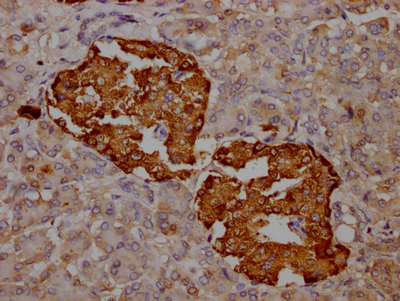
Validation in immunohistochemistry demonstrates reliable performance in formalin-fixed, paraffin-embedded human pancreatic tissue at dilutions ranging from 1:50 to 1:200, with citrate buffer antigen retrieval at pH 6.0 yielding optimal results. This tissue-based validation confirms the antibody's utility for examining TTR expression patterns in archival clinical specimens. The antibody is additionally validated for ELISA applications, providing flexibility for researchers requiring both quantitative and spatial expression data.
For investigators exploring the intersection of protein misfolding, cardiovascular pathology, and neurodegeneration, this antibody provides a dependable tool for characterizing TTR expression and distribution in human tissues.
There are currently no reviews for this product.





