
Call us
301-363-4651 (Available 9 a.m. to 5 p.m. CST from Monday to Friday)

| Code | CSB-RA025342MA1HU |
| Size | US$210 |
| Order now | |
| Image |
|
| Have Questions? | Leave a Message or Start an on-line Chat |
| Application | Recommended Dilution |
|---|---|
| IHC | 1:50-1:200 |
| FC | 1:50-1:200 |
TUFM, or mitochondrial elongation factor Tu, plays an essential role in mitochondrial protein synthesis by delivering aminoacyl-tRNAs to the ribosome during translation. This nuclear-encoded protein is critical for maintaining mitochondrial function, and mutations in TUFM have been linked to combined oxidative phosphorylation deficiency, making it a significant target for researchers investigating mitochondrial biology, metabolic disorders, and cellular energy homeostasis.
This recombinant monoclonal antibody against human TUFM offers the consistency and reliability that demanding experimental workflows require. Produced using recombinant technology with a defined sequence (clone 15F4), this antibody eliminates the lot-to-lot variability that can compromise longitudinal studies or multi-site collaborations. The human IgG1 isotype format and affinity-chromatography purification ensure high specificity for your target while minimizing background interference.
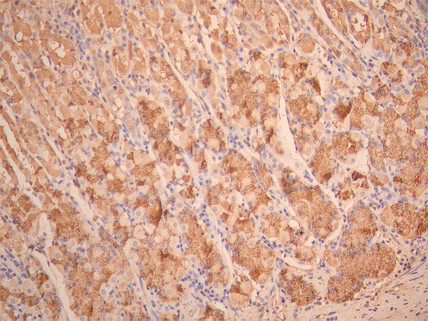
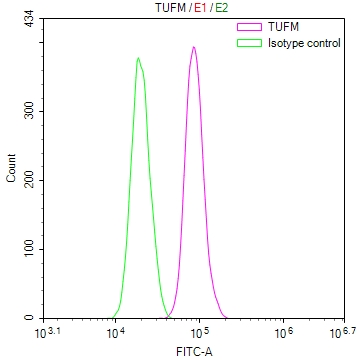
Validation studies demonstrate robust performance across multiple platforms. In immunohistochemistry, the antibody produces clear staining in paraffin-embedded human stomach tissue when used at dilutions between 1:50 and 1:200 following citrate buffer antigen retrieval. Flow cytometry validation using HeLa cells confirms reliable intracellular detection, with distinct positive signal separation from isotype control when cells are fixed and permeabilized, supporting quantitative analysis of TUFM expression at the single-cell level.
The unconjugated format provides flexibility for researchers to pair this antibody with their preferred detection systems across ELISA, immunohistochemistry, and flow cytometry applications. Whether you are exploring mitochondrial dysfunction in disease models, investigating translational regulation, or characterizing metabolic phenotypes, this TUFM antibody delivers the reproducible performance essential for meaningful research in epigenetics and nuclear signaling pathways.
There are currently no reviews for this product.





