
Call us
301-363-4651 (Available 9 a.m. to 5 p.m. CST from Monday to Friday)

| Code | CSB-RA183712A0HU |
| Size | US$210 |
| Order now | |
| Image |
|
| Have Questions? | Leave a Message or Start an on-line Chat |
| Application | Recommended Dilution |
|---|---|
| WB | 1:500-1:5000 |
| IHC | 1:50-1:200 |
| FC | 1:50-1:200 |
USP9X is a large deubiquitinating enzyme that plays essential roles in regulating protein stability, cell signaling, and developmental pathways. As a member of the ubiquitin-specific protease family, USP9X removes ubiquitin from substrate proteins, thereby protecting them from proteasomal degradation. This enzymatic activity positions USP9X as a critical modulator of numerous cellular processes, including TGF-β signaling, Wnt pathway regulation, and chromosome segregation during mitosis. Dysregulation of USP9X has been implicated in various cancers and neurodevelopmental disorders, making it a compelling target for researchers investigating oncogenic mechanisms and therapeutic vulnerabilities.
This recombinant monoclonal antibody, clone 11F2, offers the reproducibility and consistency that demanding research applications require. Generated against a synthetic peptide derived from human USP9X, the antibody is produced using recombinant technology, ensuring sequence-defined specificity and eliminating the lot-to-lot variability often encountered with traditional hybridoma-derived antibodies. Affinity chromatography purification further enhances performance by reducing background signal.
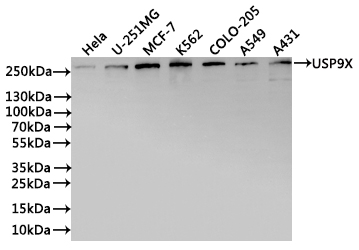
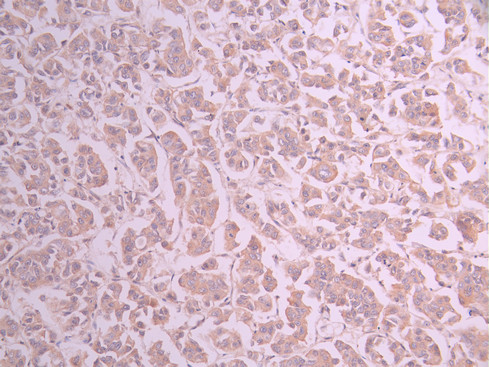
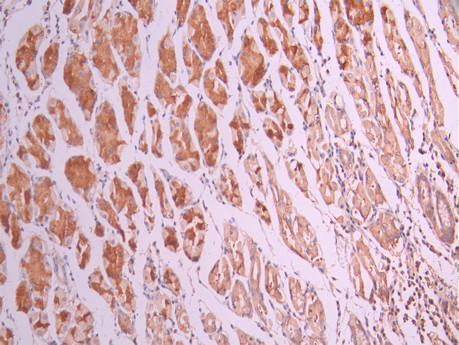
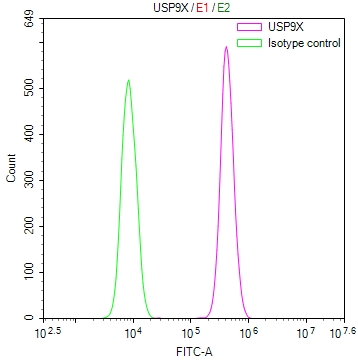
Validation studies demonstrate robust detection across multiple experimental platforms. Western blot analysis confirms specific recognition of USP9X at the expected molecular weight of approximately 292 kDa across a diverse panel of human cell lines, including HeLa, U-251MG, MCF-7, K562, COLO-205, A549, and A431 cells. Immunohistochemistry staining has been successfully performed on paraffin-embedded human breast cancer and stomach tissue sections, while flow cytometry validation in HeLa cells confirms utility for intracellular protein detection.
This antibody serves researchers investigating ubiquitin biology, cancer cell signaling, and protein quality control mechanisms, providing a reliable tool for characterizing USP9X expression and localization across multiple experimental workflows.
There are currently no reviews for this product.





