
Call us
301-363-4651 (Available 9 a.m. to 5 p.m. CST from Monday to Friday)

| Code | CSB-EP758331LAAD2 |
| Abbreviation | Recombinant Listeria monocytogenes serotype 4b inlA protein, partial |
| MSDS | |
| Size | $388 |
| Order now | |
| Image |
|
| Have Questions? | Leave a Message or Start an on-line Chat |
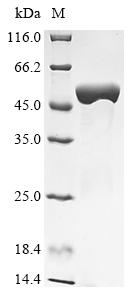
Recombinant Listeria monocytogenes serotype 4b Internalin A (inlA) is expressed in E. coli and includes an N-terminal 10xHis-tag that makes purification and detection more straightforward. The protein covers amino acids 36 to 496, which appears to provide a partial but still functional version of the native protein. SDS-PAGE analysis suggests purity levels above 90%, making this product well-suited for research applications where quality and consistency matter.
Internalin A (inlA) serves as a key surface protein on Listeria monocytogenes and plays what seems to be a central role in how the bacteria enter host cells. The protein interacts with receptors on host cells, which likely helps the pathogen invade and spread within the host. Studies focusing on inlA may contribute to our growing understanding of how bacteria cause disease and interact with their hosts, positioning it as an important research target in infectious disease work.
Potential Applications
Note: The applications listed below are based on what we know about this protein's biological functions, published research, and experience from experts in the field. However, we haven't fully tested all of these applications ourselves yet. We'd recommend running some preliminary tests first to make sure they work for your specific research goals.
Based on the provided information, the recombinant Listeria monocytogenes InlA is expressed in E. coli, a prokaryotic system that is generally suitable for producing bacterial proteins like InlA. As a bacterial surface protein expressed in a prokaryotic host, InlA has a reasonable probability of proper folding. However, the protein is expressed as a partial fragment (36-496aa) missing the N-terminal 35 amino acids, which may include important structural elements, and contains an N-terminal 10xHis tag that could potentially interfere with native protein folding. InlA requires precise folding of its leucine-rich repeat domains for proper interaction with host cell E-cadherin. While E. coli can often correctly fold bacterial proteins, the partial nature and tag may affect functionality. Since activity is unverified, the protein cannot be assumed to be correctly folded or bioactive without experimental validation of its E-cadherin binding capability.
1. Antibody Development and Validation Studies
This recombinant InlA fragment is suitable for use as an immunogen to generate antibodies. The His-tag simplifies purification and screening. The >90% purity is adequate for immunization. However, it is critical to note that antibodies generated will be against linear epitopes of this non-full-length, bacterially expressed protein. Their ability to recognize the natively folded, surface-anchored InlA on L. monocytogenesis is uncertain and must be empirically tested. These antibodies are primarily tools for detecting the denatured protein (e.g., in Western blots) or the immunogen itself.
2. Protein-Protein Interaction Studies
This application requires caution. While the His-tag enables technical feasibility for pull-down assays, if InlA is misfolded or lacks proper conformation due to the partial sequence, it may not interact physiologically with true binding partners like E-cadherin. The leucine-rich repeat domains require precise conformation for specific interactions. This application should only be pursued after confirming proper folding and E-cadherin binding capability.
3. Biochemical Characterization and Stability Studies
This application is well-suited for assessing the recombinant InlA itself. Techniques like circular dichroism spectroscopy, size-exclusion chromatography, and thermal shift assays can evaluate the protein's folding state and stability. These studies are valuable even if the protein is inactive, as they characterize the recombinant product and can inform about its suitability for other applications.
4. ELISA-Based Binding Assays
This application is high-risk without activity validation. If InlA is misfolded, binding assays will not reflect biological specificity. The protein requires proper conformation for specific E-cadherin recognition. ELISA results may show non-specific binding rather than physiological interactions. This application requires prior demonstration of proper folding and specific E-cadherin binding capability.
Final Recommendation & Action Plan
Given that InlA is a bacterial protein expressed in a prokaryotic system but with a partial sequence and tag, we recommend first performing validation studies: 1) Functional validation using E-cadherin binding assays to confirm biological activity; 2) Biophysical characterization (circular dichroism for secondary structure, analytical size-exclusion chromatography for oligomeric state) to assess folding quality; 3) If possible, comparison with full-length InlA from L. monocytogenes. Antibody development can proceed as the safest application. Avoid functional interaction studies until proper folding and E-cadherin binding are confirmed. For reliable InlA research, include appropriate controls such as known binding partners and validate findings with native protein when possible.
There are currently no reviews for this product.
KEGG: lmf:LMOf2365_0471





