
Call us
301-363-4651 (Available 9 a.m. to 5 p.m. CST from Monday to Friday)

| Code | CSB-RA438282A0HU |
| Size | US$210 |
| Order now | |
| Image |
|
| Have Questions? | Leave a Message or Start an on-line Chat |
| Application | Recommended Dilution |
|---|---|
| WB | 1:500-1:5000 |
| FC | 1:50-1:200 |
ADRBK2, also known as G-protein-coupled receptor kinase 3 (GRK3), plays a central role in regulating signal transduction by phosphorylating and desensitizing activated G-protein-coupled receptors. This kinase is particularly important in modulating beta-adrenergic receptor signaling pathways, making it a key target for researchers investigating receptor regulation, cellular signaling dynamics, and related physiological processes.
This recombinant monoclonal antibody offers the consistency and reliability that demanding experimental workflows require. Produced using recombinant technology with a defined sequence, it eliminates the lot-to-lot variability that can compromise longitudinal studies or multi-site collaborations. The rabbit IgG format, generated from clone 21C6, has been affinity-purified to ensure high specificity against human ADRBK2.
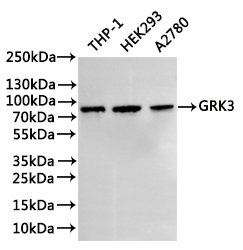
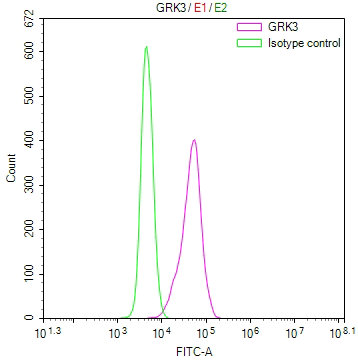
Validation data demonstrates robust performance across multiple applications. In western blot analysis, the antibody detects a clear band at the predicted 80 kDa molecular weight across diverse human cell lines, including THP-1 monocytes, HEK293 cells, and A2780 ovarian carcinoma cells, confirming reliable detection across different cellular contexts. The recommended dilution range of 1:500 to 1:5000 provides flexibility for optimization in your specific experimental system. Flow cytometry validation using SH-SY5Y neuroblastoma cells shows distinct positive staining compared to isotype controls, demonstrating suitability for intracellular protein detection in fixed and permeabilized cells at dilutions between 1:50 and 1:200.
Whether you are investigating GPCR desensitization mechanisms, mapping signal transduction networks, or exploring receptor kinase biology in disease models, this antibody provides a dependable tool with demonstrated performance in both protein quantification and single-cell analysis applications.
There are currently no reviews for this product.





