
Call us
301-363-4651 (Available 9 a.m. to 5 p.m. CST from Monday to Friday)

| Code | CSB-RA794271A0HU |
| Size | US$210 |
| Order now | |
| Image |
|
| Have Questions? | Leave a Message or Start an on-line Chat |
| Application | Recommended Dilution |
|---|---|
| WB | 1:500-1:5000 |
| IHC | 1:50-1:200 |
| FC | 1:50-1:200 |
ATG3 serves as a critical E2-like conjugating enzyme in the autophagy pathway, facilitating the lipidation of LC3 proteins essential for autophagosome formation. This process plays a fundamental role in cellular homeostasis, stress responses, and has significant implications in cancer biology, neurodegeneration, and metabolic disorders, making ATG3 a valuable target for researchers investigating autophagy mechanisms.
This recombinant monoclonal antibody, developed using rabbit host immunization against a synthetic peptide derived from human ATG3, offers the reproducibility and consistency that demanding autophagy research requires. As a sequence-defined recombinant clone, it eliminates the lot-to-lot variability that can complicate longitudinal studies, ensuring your experimental conditions remain constant across projects.
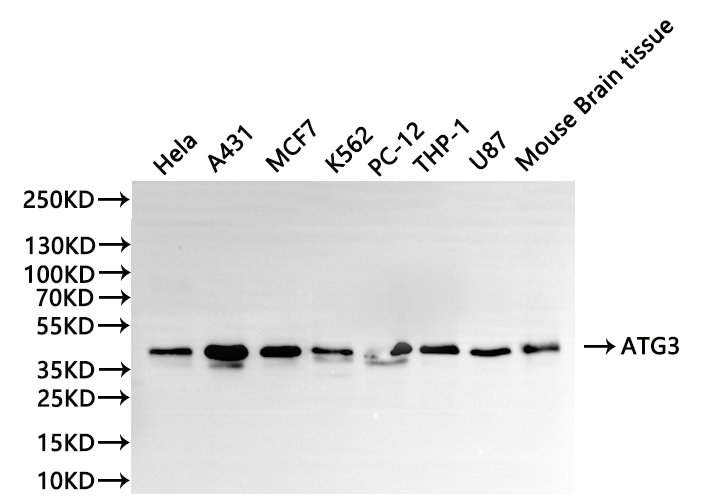
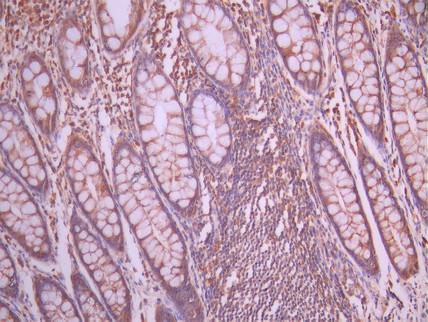
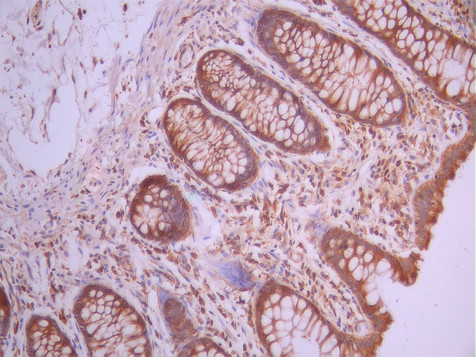
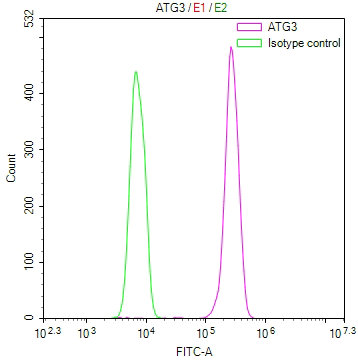
Validation data demonstrates robust performance across multiple applications. In Western blot analysis, the antibody detects ATG3 at approximately 40 kDa across a diverse panel of human cell lines including HeLa, A431, MCF-7, K562, THP-1, and U-87MG, as well as mouse brain tissue lysate, confirming cross-species reactivity with both human and mouse samples. The apparent molecular weight of the band exceeds the predicted 36 kDa. This may be explained by either the presence of low-abundance post-translational modifications (such as glycosylation or phosphorylation) on ATG3 under physiological conditions, or by the deviation in SDS-PAGE mobility caused by its amino acid composition. Immunohistochemistry validation in paraffin-embedded human small intestine and colorectal cancer tissues demonstrates clear staining patterns suitable for tissue-based studies. Flow cytometry analysis in HeLa cells shows distinct signal separation from isotype controls, supporting intracellular detection applications.
Whether you are investigating autophagy flux, screening therapeutic compounds targeting this pathway, or characterizing ATG3 expression in disease models, this antibody provides the flexibility to move seamlessly between Western blot, immunohistochemistry, and flow cytometry workflows within your cell biology research.
There are currently no reviews for this product.





