
Call us
301-363-4651 (Available 9 a.m. to 5 p.m. CST from Monday to Friday)

| Code | CSB-RA104772A0HU |
| Size | US$210 |
| Order now | |
| Image |
|
| Have Questions? | Leave a Message or Start an on-line Chat |
| Application | Recommended Dilution |
|---|---|
| WB | 1:500-1:2000 |
BAG2 serves as a critical co-chaperone that regulates protein quality control pathways, working alongside HSP70 family members to influence protein folding, degradation, and cellular stress responses. This molecular chaperone regulator has gained significant research attention for its roles in proteasomal degradation, tau protein homeostasis relevant to neurodegenerative disease, and emerging connections to cancer biology where it may influence tumor suppressor pathways.
This recombinant monoclonal antibody, clone 11B5, offers the reproducibility essential for longitudinal studies and multi-site collaborations. Because the antibody sequence is defined and production occurs in controlled recombinant systems, you can expect consistent performance across different lots—eliminating the variability that can complicate data interpretation when working with traditional hybridoma-derived antibodies.
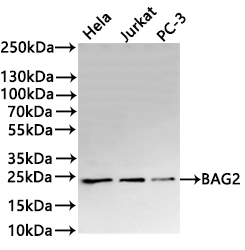
Validation by western blot demonstrates reliable detection of BAG2 across multiple human cell lines, including HeLa, Jurkat, and PC-3 lysates. The antibody produces a clean signal at the expected 24 kDa molecular weight, confirming specific recognition of the target protein without apparent degradation products or non-specific bands under standard conditions. This performance across epithelial, T-lymphocyte, and prostate carcinoma cell backgrounds suggests robust utility for researchers working with diverse experimental models. The validated dilution range of 1:500 to 1:2000 for western blotting provides flexibility to optimize signal intensity based on your specific sample conditions and detection systems.
Whether investigating chaperone-mediated autophagy, exploring BAG2's influence on protein aggregation disorders, or examining its potential contributions to oncogenic signaling, this antibody provides a dependable tool for characterizing BAG2 expression and regulation in human experimental systems.
There are currently no reviews for this product.





