
Call us
301-363-4651 (Available 9 a.m. to 5 p.m. CST from Monday to Friday)

| Code | CSB-RA164531A0HU |
| Size | US$210 |
| Order now | |
| Image |
|
| Have Questions? | Leave a Message or Start an on-line Chat |
| Application | Recommended Dilution |
|---|---|
| WB | 1:500-1:5000 |
| FC | 1:50-1:200 |
BCL10 serves as a critical signaling adapter protein that bridges antigen receptor activation to NF-κB pathway engagement, making it essential for understanding lymphocyte development, immune responses, and lymphomagenesis. Originally identified through its involvement in the t(1;14) translocation associated with MALT lymphoma, BCL10 has since emerged as a key player in the CBM signalosome complex, where it facilitates signal transduction from diverse immunoreceptors.
This recombinant monoclonal antibody, clone 4D9, offers the reproducibility and consistency that demanding research applications require. Generated in rabbit and produced through recombinant technology, it provides sequence-defined specificity against human BCL10, eliminating the lot-to-lot variability that can compromise longitudinal studies or multi-site collaborations. The antibody was raised against a synthetic peptide derived from human BCL10, ensuring targeted epitope recognition.
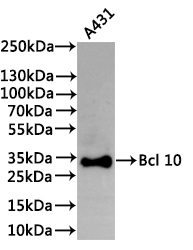
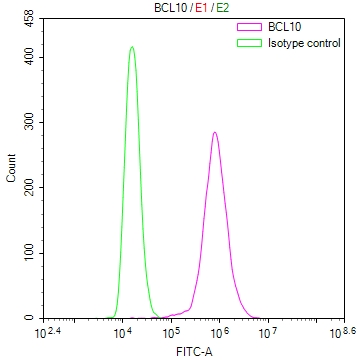
Validation studies demonstrate reliable performance across multiple platforms. In western blot analysis using A431 whole cell lysate, the antibody detects a band at approximately 31 kDa, slightly larger than the predicted 26 kDa molecular weight. This size difference likely reflects post-translational modifications, including phosphorylation events known to regulate BCL10 function during immune signaling. Flow cytometry validation in BxPC-3 cells confirms robust intracellular detection with clear separation from isotype control, supporting applications in cell-based signaling studies.
With validated performance in ELISA and flow cytometry at working dilutions of 1:50–1:200, this antibody supports diverse experimental workflows investigating NF-κB signaling, lymphocyte biology, and oncogenic mechanisms. Researchers studying MALT lymphoma pathogenesis, T-cell receptor signaling, or inflammatory pathway regulation will find this reagent well-suited to their investigative needs.
There are currently no reviews for this product.





