
Call us
301-363-4651 (Available 9 a.m. to 5 p.m. CST from Monday to Friday)

| Code | CSB-RA247067A0HU |
| Size | US$210 |
| Order now | |
| Image |
|
| Have Questions? | Leave a Message or Start an on-line Chat |
| Application | Recommended Dilution |
|---|---|
| IHC | 1:50-1:200 |
Calbindin-D28K, encoded by the CALB1 gene, serves as a critical calcium-buffering protein with particular importance in neuroscience research. This vitamin D-dependent calcium-binding protein plays essential roles in neuronal calcium homeostasis, protecting cells from calcium-mediated excitotoxicity and contributing to synaptic plasticity. Its expression patterns in specific neuronal populations, including cerebellar Purkinje cells and hippocampal interneurons, make it a valuable marker for studying neuronal subtype identification, neurodegenerative processes, and calcium signaling pathways.
This recombinant monoclonal antibody, clone 1D1, offers researchers the reproducibility advantages inherent to recombinant technology. Because the antibody sequence is defined and produced from a stable expression system, you can expect consistent performance across experiments and between lots, eliminating the variability concerns that can complicate long-term studies or multi-site collaborations. The rabbit host and monoclonal nature combine high specificity with robust signal generation.
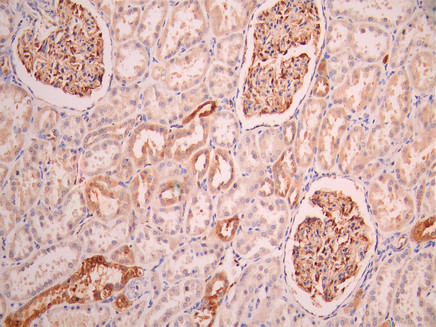
Validation testing confirms reliable performance in immunohistochemistry applications, with successful staining demonstrated in paraffin-embedded human kidney tissue using a standard citrate buffer antigen retrieval protocol at pH 6.0. The recommended working dilution range of 1:50 to 1:200 provides flexibility for optimization across different tissue types and detection systems. Additional ELISA compatibility extends the antibody's utility for quantitative applications.
Supplied in a glycerol-containing buffer optimized for long-term stability at -20°C or -80°C, this affinity-purified antibody arrives ready for immediate use in your calcium-binding protein studies. Whether investigating neuronal calcium dynamics, mapping calbindin-expressing cell populations, or exploring vitamin D-dependent signaling mechanisms, this antibody provides a dependable tool for advancing your neuroscience research.
There are currently no reviews for this product.





