
Call us
301-363-4651 (Available 9 a.m. to 5 p.m. CST from Monday to Friday)

| Code | CSB-RA228590A0HU |
| Size | US$210 |
| Order now | |
| Image |
|
| Have Questions? | Leave a Message or Start an on-line Chat |
| Application | Recommended Dilution |
|---|---|
| WB | 1:500-1:2000 |
| FC | 1:50-1:200 |
Caveolin-1 serves as the principal structural component of caveolae, the flask-shaped plasma membrane invaginations that orchestrate diverse cellular processes including signal transduction, lipid homeostasis, and endocytosis. This scaffolding protein directly modulates the activity of numerous signaling molecules, making it a critical node in pathways governing cell proliferation, migration, and metabolism. Its dysregulation has been implicated across multiple disease contexts, from cardiovascular dysfunction to tumor progression, where CAV1 can function as either a tumor suppressor or promoter depending on cellular context.
This recombinant monoclonal antibody, generated from clone 2A7 against a synthetic peptide derived from human CAV1, offers the reproducibility and consistency that demanding experimental workflows require. Because recombinant antibodies are produced from defined sequences rather than hybridoma-derived sources, researchers benefit from lot-to-lot uniformity that supports longitudinal studies and ensures comparable results across experiments.
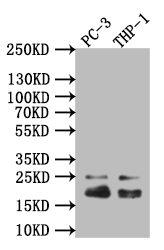
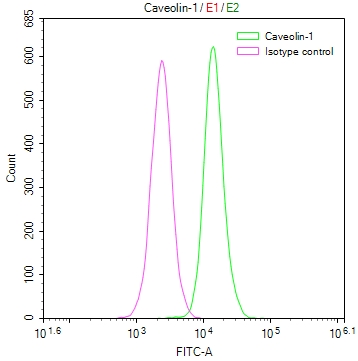
Validation studies confirm reliable performance across multiple platforms. Western blot analysis of THP-1 whole cell lysate demonstrates specific detection of a 20 kDa band, matching the predicted molecular weight for caveolin-1 and indicating recognition of the native protein without aberrant migration artifacts. Flow cytometry validation in HeLa cells, using appropriate fixation and permeabilization conditions, shows clear positive signal separation from isotype control, confirming utility for intracellular protein quantification at the single-cell level.
The antibody's validated compatibility with ELISA, western blotting, and flow cytometry provides flexibility for researchers investigating caveolin-1 across cancer biology, cardiovascular research, metabolic studies, and signal transduction pathways where this multifunctional protein plays regulatory roles.
There are currently no reviews for this product.





