
Call us
301-363-4651 (Available 9 a.m. to 5 p.m. CST from Monday to Friday)

| Code | CSB-RA004571MA1HU |
| Size | US$210 |
| Order now | |
| Image |
|
| Have Questions? | Leave a Message or Start an on-line Chat |
| Application | Recommended Dilution |
|---|---|
| WB | 1:500-1:2000 |
| FC | 1:50-1:200 |
Caveolin-1 serves as the principal structural component of caveolae, specialized plasma membrane invaginations that orchestrate diverse cellular processes including signal transduction, lipid homeostasis, and endocytosis. This scaffolding protein directly modulates key signaling cascades by interacting with receptor tyrosine kinases, G-proteins, and Src family kinases, making it a critical node in understanding cancer progression, cardiovascular function, and metabolic regulation. Dysregulation of CAV1 expression has been implicated in tumor suppression and promotion depending on cellular context, positioning it as a compelling target for oncology and metabolic disease research.
This recombinant monoclonal antibody, clone 24F6, offers the reproducibility and sequence-defined consistency that demanding experimental workflows require. Generated against recombinant human CAV1 protein and produced using recombinant technology, it eliminates the lot-to-lot variability that can compromise longitudinal studies and multi-site collaborations. The mouse IgG2a isotype and affinity-chromatography purification ensure reliable performance across repeated experiments.
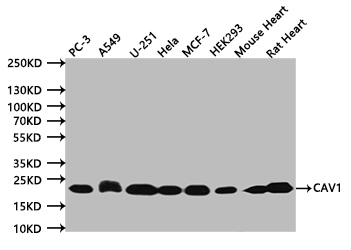
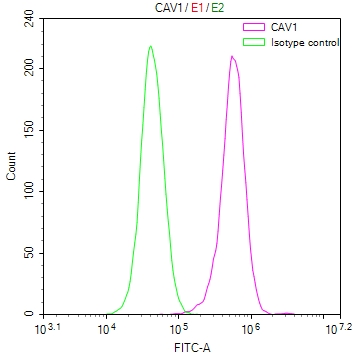
Validation studies demonstrate robust detection across multiple experimental platforms. In western blot applications, the antibody identifies CAV1 at the expected 20 kDa molecular weight across a diverse panel of human cell lines including PC-3, A549, U251, HeLa, MCF-7, and HEK293, as well as mouse and rat heart tissue lysates, confirming cross-species reactivity for translational research models. Flow cytometry validation in HeLa cells shows clear separation from isotype controls, supporting intracellular detection applications with recommended dilutions between 1:50 and 1:200.
Whether investigating caveolae-mediated signaling in cancer biology, exploring cardiovascular membrane dynamics, or characterizing metabolic pathways, this antibody provides the experimental flexibility researchers need to advance their work with confidence.
There are currently no reviews for this product.





