
Call us
301-363-4651 (Available 9 a.m. to 5 p.m. CST from Monday to Friday)

| Code | CSB-RA093733A0HU |
| Size | US$210 |
| Order now | |
| Image |
|
| Have Questions? | Leave a Message or Start an on-line Chat |
| Application | Recommended Dilution |
|---|---|
| IHC | 1:50-1:200 |
| FC | 1:50-1:200 |
Cyclin B2 plays a central role in cell cycle progression, functioning as a regulatory subunit of cyclin-dependent kinases during the G2/M transition. As a key component of the mitotic machinery, CCNB2 accumulates during S and G2 phases before being rapidly degraded at the metaphase-anaphase transition, making it an important marker for studying cell proliferation, mitotic entry, and checkpoint regulation in both normal and malignant cells.
This recombinant monoclonal antibody offers the reproducibility and consistency that demanding research applications require. Generated through recombinant expression technology and derived from a single clone, it provides sequence-defined specificity that eliminates the lot-to-lot variability often encountered with traditional hybridoma-derived antibodies. The rabbit IgG format, combined with affinity chromatography purification, ensures high purity and reliable performance across experiments.
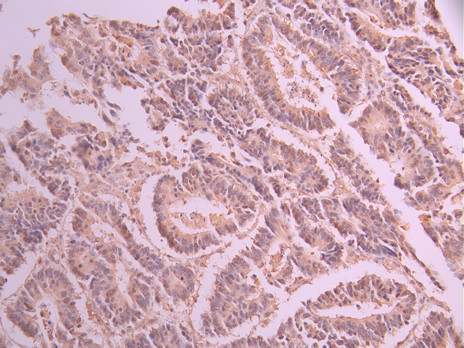
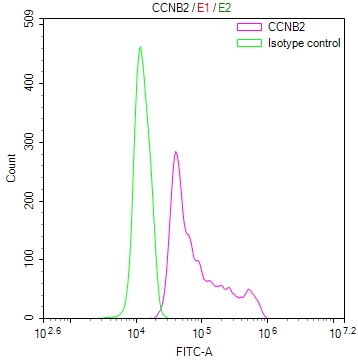
Validation studies demonstrate this antibody's utility across multiple experimental platforms. Immunohistochemistry performed on paraffin-embedded human colorectal cancer tissue shows clear detection of CCNB2 at dilutions between 1:50 and 1:200, with successful staining achieved using standard citrate buffer antigen retrieval. Flow cytometry analysis using HeLa cells confirms intracellular detection capability, with distinct positive signal separation from isotype control, supporting its application in cell cycle studies using this widely-used human cervical carcinoma model.
The validated performance in both tissue sections and cell-based assays makes this antibody well-suited for researchers investigating mitotic regulation, cancer cell proliferation, and cell cycle dynamics. Its compatibility with fixed and permeabilized samples provides flexibility for characterizing CCNB2 expression patterns in human tumor specimens and cultured cell populations.
There are currently no reviews for this product.





