
Call us
301-363-4651 (Available 9 a.m. to 5 p.m. CST from Monday to Friday)

| Code | CSB-RA265446A0HU |
| Size | US$210 |
| Order now | |
| Image |
|
| Have Questions? | Leave a Message or Start an on-line Chat |
| Application | Recommended Dilution |
|---|---|
| IF | 1:50-1:200 |
| FC | 1:50-1:200 |
CEBPB (CCAAT/enhancer-binding protein beta) is a transcription factor that plays a central role in regulating genes involved in immune and inflammatory responses, cellular differentiation, and metabolic processes. Also known as NF-IL6, this protein mediates interleukin-6-dependent gene activation and serves as a critical regulator in adipogenesis, liver function, and macrophage activation. Its involvement in both normal physiology and disease states, including cancer progression and metabolic disorders, makes CEBPB an important target for researchers investigating transcriptional regulation and cellular stress responses.
This recombinant monoclonal antibody, clone 11C7, offers the reproducibility and consistency that demanding experimental workflows require. Generated using recombinant technology with a defined sequence, this antibody eliminates the lot-to-lot variability that can compromise longitudinal studies or multi-site collaborations. The rabbit host and monoclonal nature ensure high specificity for human CEBPB, while affinity chromatography purification delivers a clean reagent suitable for sensitive detection methods.
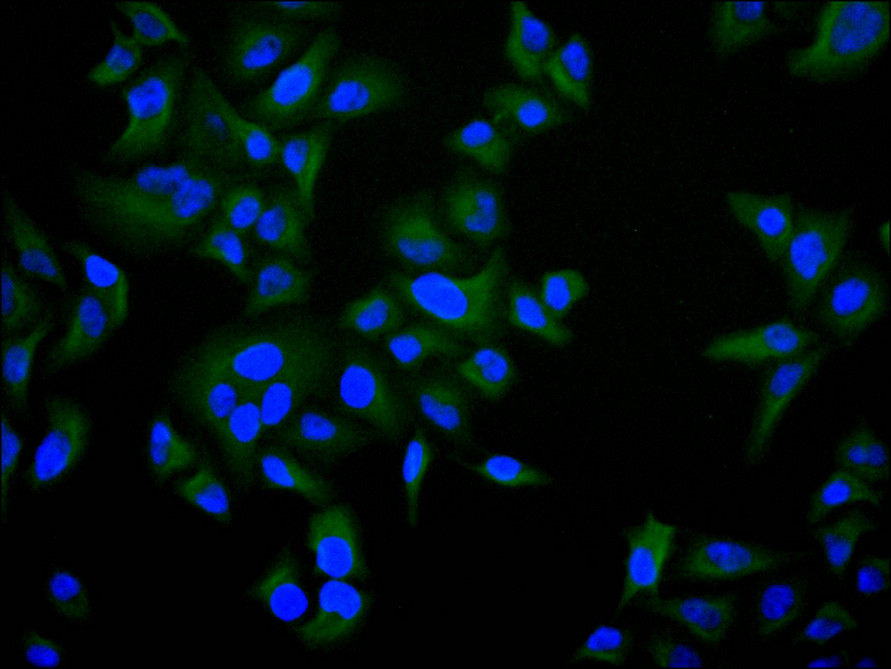
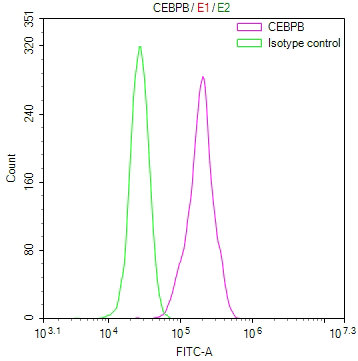
Validation studies demonstrate reliable performance in immunofluorescence and flow cytometry applications. Immunofluorescence staining of HeLa cells at dilutions of 1:50 to 1:200 reveals clear nuclear localization consistent with CEBPB's function as a transcription factor. Flow cytometry analysis using HepG2 hepatocellular carcinoma cells shows distinct positive signal separation from isotype control, confirming specific detection in this liver-derived cell line particularly relevant to CEBPB biology.
This antibody supports research into inflammatory signaling pathways, adipocyte differentiation, hepatic gene regulation, and cancer biology where CEBPB dysregulation contributes to disease progression. The validated performance across multiple cell-based applications provides flexibility for researchers studying this transcription factor in diverse experimental contexts.
There are currently no reviews for this product.





