
Call us
301-363-4651 (Available 9 a.m. to 5 p.m. CST from Monday to Friday)

| Code | CSB-RA028796A0HU |
| Size | US$210 |
| Order now | |
| Image |
|
| Have Questions? | Leave a Message or Start an on-line Chat |
| Application | Recommended Dilution |
|---|---|
| WB | 1:500-1:2000 |
| FC | 1:50-1:200 |
CTNNA1, also known as alpha-catenin, serves as a critical mechanosensor linking the cadherin-catenin complex to the actin cytoskeleton. This 100 kDa protein plays essential roles in establishing and maintaining cell-cell adhesion, with its dysfunction implicated in epithelial-to-mesenchymal transition and cancer progression. Researchers investigating adherens junction dynamics, tissue morphogenesis, or tumor invasion mechanisms require reliable tools to detect this fundamental structural protein.
This recombinant monoclonal antibody, generated against a synthetic peptide derived from human CTNNA1, offers the reproducibility that demanding research applications require. As a sequence-defined recombinant clone, it eliminates the lot-to-lot variability inherent to traditional hybridoma-derived antibodies, ensuring your experimental conditions remain consistent across long-term studies and collaborative projects.
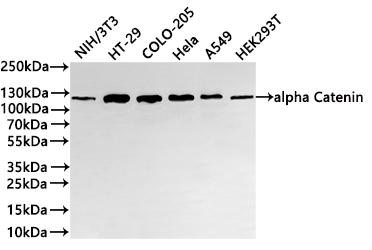
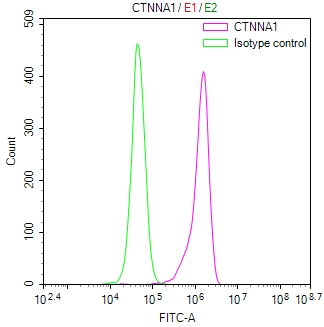
Western blot validation demonstrates robust detection across a diverse panel of cell lines, including NIH/3T3, HT-29, COLO-205, HeLa, A549, and HEK293T lysates at working dilutions of 1:500 to 1:2000. The observed band at 115 kDa, slightly higher than the predicted 100 kDa molecular weight, likely reflects post-translational modifications such as phosphorylation events known to regulate alpha-catenin function. Flow cytometry applications have been validated using MCF-7 cells with intracellular staining protocols, confirming utility for single-cell analysis of this cytoplasmic protein at dilutions between 1:50 and 1:200.
With confirmed cross-species reactivity for human and mouse samples, this antibody supports both clinical specimen analysis and murine model studies. Whether you are characterizing junction assembly in developmental contexts, screening for adhesion defects in cancer cell lines, or investigating mechanotransduction pathways, this CTNNA1 antibody provides the specificity and consistency your research demands.
There are currently no reviews for this product.





