
Call us
301-363-4651 (Available 9 a.m. to 5 p.m. CST from Monday to Friday)

| Code | CSB-RA006327MA1HU |
| Size | $49.9 |
| Order now | |
| Promotion |

|
| Image |
|
| Have Questions? | Leave a Message or Start an on-line Chat |
| Application | Recommended Dilution |
|---|---|
| WB | 1:500-1:2000 |
| FC | 1:50-1:200 |
Cytochrome c1 (CYC1) serves as an essential component of the mitochondrial respiratory chain, functioning within Complex III (ubiquinol-cytochrome c reductase) to facilitate electron transfer during oxidative phosphorylation. This protein plays a fundamental role in cellular energy metabolism, making it a valuable marker for studies investigating mitochondrial function, bioenergetics, and metabolic disorders.
This recombinant monoclonal antibody targeting human CYC1 offers researchers the reliability that comes with sequence-defined production. Unlike traditional hybridoma-derived antibodies, recombinant technology ensures consistent performance across lots, eliminating the variability that can compromise longitudinal studies or require repeated optimization. The human IgG1 isotype format and affinity-chromatography purification contribute to a reagent designed for reproducible results.
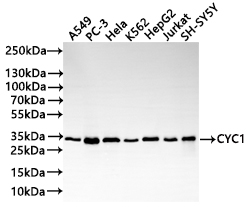
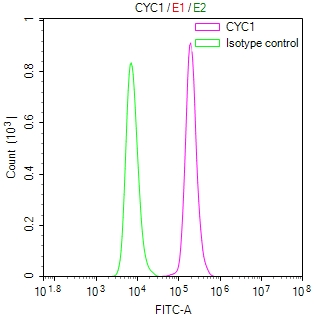
Validation studies demonstrate robust performance across multiple experimental platforms. Western blot analysis confirms specific detection of CYC1 at the predicted molecular weight of 35 kDa across a diverse panel of human cell lines, including A549, PC-3, HeLa, K562, HepG2, Jurkat, and SH-SY5Y cells at recommended dilutions of 1:500–1:2000. This broad cell line compatibility reflects the ubiquitous expression of mitochondrial respiratory components and provides flexibility for researchers working with various cellular models. Flow cytometry validation in PC-3 cells further demonstrates the antibody's utility for single-cell analysis of intracellular CYC1 expression, with clear separation from isotype control at dilutions of 1:50–1:200.
This antibody supports research into mitochondrial dysfunction, cancer metabolism, neurodegenerative diseases, and cellular bioenergetics where understanding Complex III activity and expression is essential for advancing mechanistic insights.
There are currently no reviews for this product.





