
Call us
301-363-4651 (Available 9 a.m. to 5 p.m. CST from Monday to Friday)

| Code | CSB-RA289302A0HU |
| Size | US$210 |
| Order now | |
| Image |
|
| Have Questions? | Leave a Message or Start an on-line Chat |
| Application | Recommended Dilution |
|---|---|
| WB | 1:500-1:2000 |
DDR2 (Discoidin domain-containing receptor 2) is a receptor tyrosine kinase that plays a critical role in cell-matrix interactions, responding specifically to collagen as its ligand. This unique activation mechanism positions DDR2 as a key regulator of processes including cell migration, proliferation, and extracellular matrix remodeling, making it particularly relevant to cardiovascular research and neuroscience investigations where tissue architecture and cellular communication are central to understanding disease mechanisms.
This recombinant monoclonal antibody (clone 9A9) offers the consistency and reliability that demanding experimental workflows require. Because it is produced from a defined sequence in a controlled expression system, researchers can expect reproducible performance across experiments and over time, eliminating the lot-to-lot variability that can complicate long-term studies or multi-site collaborations.
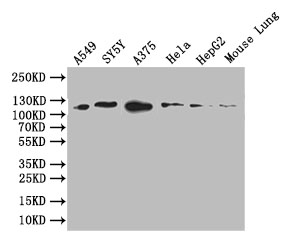
Validation by western blot demonstrates robust detection across a diverse panel of human cell lines, including A549, SY5Y, A375, and HEPG2, as well as mouse lung tissue lysate, confirming cross-species reactivity between human and mouse samples. The antibody detects a band at approximately 110 kDa, which is slightly higher than the predicted 96 kDa molecular weight. This size difference is commonly attributed to post-translational modifications such as glycosylation, which is expected for a transmembrane receptor tyrosine kinase like DDR2. Optimal results in western blot applications are achieved at dilutions between 1:500 and 1:2000.
Whether investigating DDR2's role in cardiac fibrosis, neuronal development, or tumor microenvironment interactions, this antibody provides a dependable tool for researchers seeking to characterize DDR2 expression and explore its functional significance in both human and mouse model systems.
There are currently no reviews for this product.





