
Call us
301-363-4651 (Available 9 a.m. to 5 p.m. CST from Monday to Friday)

| Code | CSB-RA555849A0HU |
| Size | US$210 |
| Order now | |
| Image |
|
| Have Questions? | Leave a Message or Start an on-line Chat |
| Application | Recommended Dilution |
|---|---|
| IF | 1:20-1:200 |
Fibroblast growth factor receptor 3 plays a central role in regulating cell proliferation, differentiation, and survival across multiple tissue types. As a receptor tyrosine kinase, FGFR3 transduces extracellular signals that influence skeletal development, and its dysregulation through activating mutations or overexpression has been implicated in various malignancies, including bladder cancer and multiple myeloma. This makes FGFR3 a compelling target for researchers investigating oncogenic signaling pathways, cardiovascular biology, and stem cell differentiation.
This recombinant monoclonal antibody, generated in rabbit using clone 5B6, offers the reproducibility and consistency that demanding experimental workflows require. Because recombinant antibodies are produced from defined genetic sequences rather than traditional hybridoma methods, you can expect reliable performance across experiments and between lots, eliminating a common source of variability that can complicate long-term studies or multi-site collaborations. The antibody was raised against a synthetic peptide derived from human FGFR3 and has been validated for reactivity with human samples.
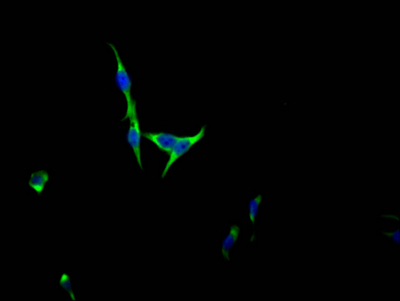
Validation studies demonstrate effective performance in immunofluorescence applications, where staining of HepG2 cells at 1:50 dilution revealed clear signal when counter-stained with DAPI and detected using FITC-conjugated secondary antibody. This hepatocellular carcinoma cell line provides a relevant model for studying FGFR3 in cancer contexts. For immunofluorescence experiments, dilutions ranging from 1:20 to 1:200 are recommended, allowing flexibility to optimize signal intensity based on your specific experimental conditions and detection systems.
Whether you are investigating FGFR3-mediated signal transduction, exploring its role in tumor progression, or examining receptor dynamics in stem cell populations, this antibody provides a dependable tool for advancing your research.
There are currently no reviews for this product.





