
Call us
301-363-4651 (Available 9 a.m. to 5 p.m. CST from Monday to Friday)

| Code | CSB-RA891358A0HU |
| Size | US$210 |
| Order now | |
| Image |
|
| Have Questions? | Leave a Message or Start an on-line Chat |
| Application | Recommended Dilution |
|---|---|
| IHC | 1:50-1:200 |
Growth hormone 1, also known as somatotropin, serves as a master regulator of postnatal growth and metabolism, orchestrating processes from linear bone growth to protein synthesis and lipid mobilization. Produced primarily by somatotroph cells in the anterior pituitary, GH1 exerts its effects through both direct receptor binding and stimulation of insulin-like growth factor 1 production. Understanding GH1 expression patterns and regulation remains central to research spanning developmental biology, endocrine disorders, and metabolic signaling pathways.
This recombinant monoclonal antibody, clone 5E9, offers the consistency and reliability that demanding research applications require. Generated against a synthetic peptide derived from human growth hormone and produced using recombinant technology in rabbit host, this antibody provides sequence-defined specificity with exceptional lot-to-lot reproducibility. The monoclonal nature ensures that every vial delivers identical binding characteristics, eliminating the variability that can complicate longitudinal studies or multi-site collaborations.
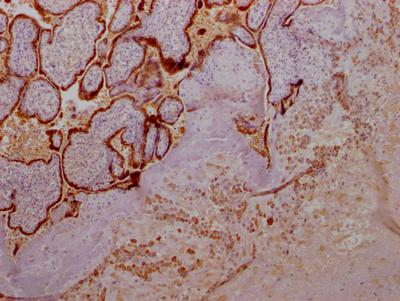
Validation in immunohistochemistry demonstrates clear detection in human placenta tissue, where GH1 variant expression plays important roles in fetal development and maternal metabolic adaptation. Testing at 1:100 dilution using citrate buffer antigen retrieval on a Leica Bond system produced reliable staining, with the recommended working range of 1:50 to 1:200 allowing optimization flexibility for different tissue preparations. The antibody is also validated for ELISA applications, supporting quantitative measurement workflows.
Supplied in a glycerol-containing buffer optimized for long-term stability at -20°C or -80°C, this affinity-purified antibody arrives ready for immediate use in studies exploring growth hormone biology, pituitary function, or developmental signaling mechanisms.
There are currently no reviews for this product.





