
Call us
301-363-4651 (Available 9 a.m. to 5 p.m. CST from Monday to Friday)

| Code | CSB-RA280351A0HU |
| Size | US$210 |
| Order now | |
| Image |
|
| Have Questions? | Leave a Message or Start an on-line Chat |
| Application | Recommended Dilution |
|---|---|
| WB | 1:500-1:2000 |
| IHC | 1:50-1:200 |
| FC | 1:50-1:200 |
GTF2F2, also known as RAP30 or TFIIF-beta, serves as the small subunit of the general transcription factor IIF complex, playing an essential role in RNA polymerase II-mediated transcription initiation. This 30 kDa protein possesses ATP-dependent helicase activity and functions alongside its larger partner subunit to recruit RNA polymerase II to promoter regions and stabilize the preinitiation complex. Understanding GTF2F2's regulatory mechanisms provides valuable insights into fundamental transcriptional control and its dysregulation in disease states.
This recombinant monoclonal antibody, generated against a synthetic peptide derived from human GTF2F2, offers the reproducibility and consistency that demanding research applications require. As a sequence-defined reagent produced through recombinant technology, clone 7F8 eliminates the lot-to-lot variability often encountered with traditional hybridoma-derived antibodies, ensuring your experimental results remain comparable across extended studies.
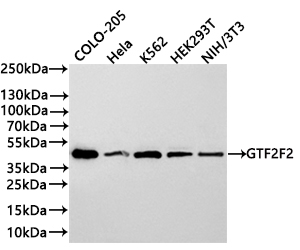
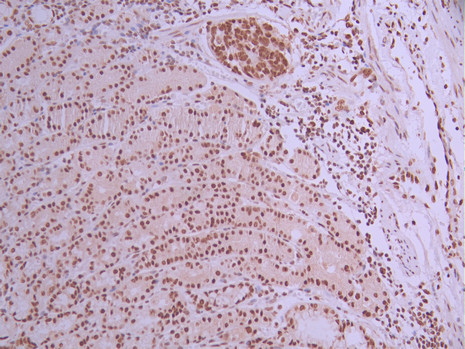
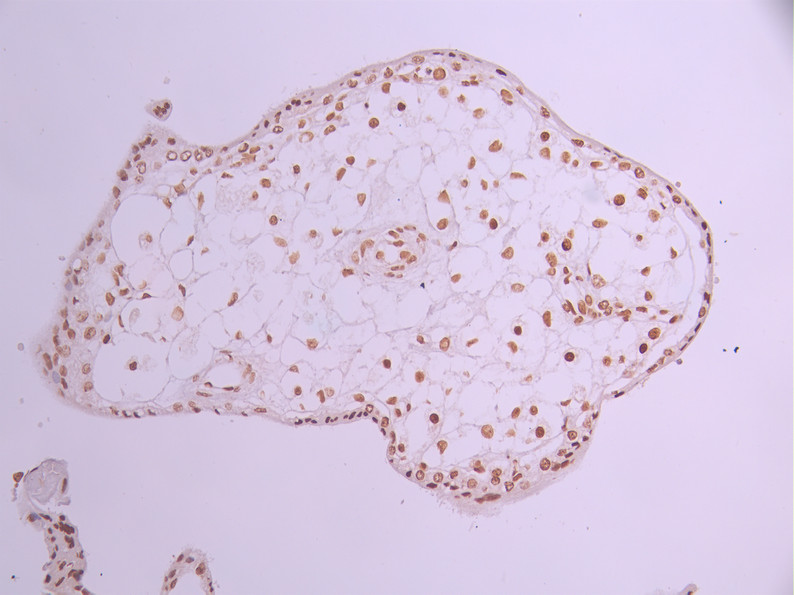
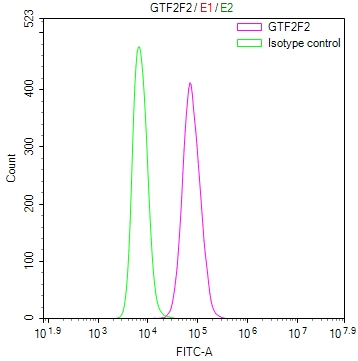
Validation across multiple platforms demonstrates this antibody's versatility in your workflow. Western blot analysis confirms specific detection in diverse human cell lines including COLO-205, HeLa, K562, and HEK293T, with the observed band at approximately 30 kDa slightly exceeding the predicted 28 kDa molecular weight—a difference likely attributable to post-translational modifications. Cross-species reactivity with mouse samples has been validated in NIH/3T3 lysates, expanding utility for comparative studies. Immunohistochemistry staining has been successfully performed in human gastric cancer and placenta tissues, while flow cytometry validation in HT29 cells demonstrates clear positive signal separation from isotype controls.
This antibody supports researchers investigating transcriptional regulation, cancer biology, and fundamental gene expression mechanisms where reliable GTF2F2 detection across multiple experimental approaches is essential.
There are currently no reviews for this product.





