
Call us
301-363-4651 (Available 9 a.m. to 5 p.m. CST from Monday to Friday)

| Code | CSB-RA825804A0HU |
| Size | US$210 |
| Order now | |
| Image |
|
| Have Questions? | Leave a Message or Start an on-line Chat |
| Application | Recommended Dilution |
|---|---|
| WB | 1:500-1:2000 |
| IHC | 1:50-1:200 |
| FC | 1:50-1:200 |
Hexokinase 1 serves as the first rate-limiting enzyme in glycolysis, catalyzing the phosphorylation of glucose to glucose-6-phosphate. This brain-predominant isoform plays a central role in cellular energy metabolism and has garnered significant research attention due to its involvement in metabolic reprogramming, particularly in cancer biology and neurological studies where altered glucose utilization is a hallmark feature.
This recombinant monoclonal antibody, generated against a synthetic peptide derived from human HK1, offers the reproducibility and consistency that demanding experimental workflows require. As a sequence-defined reagent produced through recombinant technology, it eliminates the lot-to-lot variability inherent in traditional hybridoma-derived antibodies, ensuring your results remain comparable across extended studies and collaborative projects.
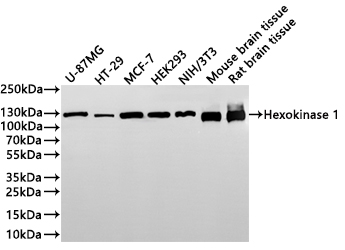
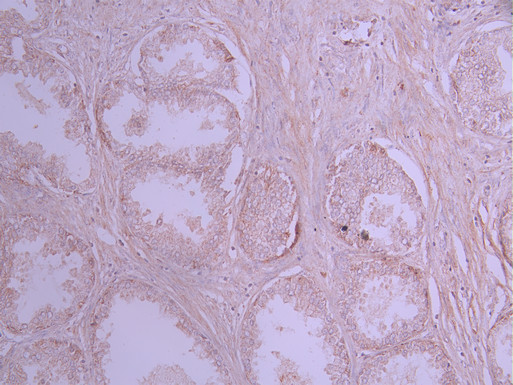
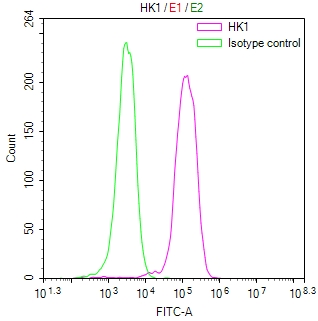
Validation across multiple platforms demonstrates this antibody's versatility in your research toolkit. Western blot analysis confirms robust detection in human cell lines including U-87MG glioblastoma, HT-29 colorectal carcinoma, MCF-7 breast cancer, and HEK293 cells, with cross-species reactivity verified in NIH/3T3 mouse cells and both mouse and rat brain tissue lysates. The observed molecular weight of 120-130 kDa, slightly higher than the predicted 102 kDa, reflects the post-translational modification or complex formation of HK1. Immunohistochemistry validation in paraffin-embedded human prostate cancer tissue and flow cytometry analysis in MCF-7 cells further expand its application range.
Whether investigating metabolic dysfunction in neurodegeneration, exploring the Warburg effect in tumor biology, or characterizing glucose metabolism in cellular models, this antibody provides a reliable tool for detecting HK1 across diverse experimental contexts and sample types.
There are currently no reviews for this product.





