
Call us
301-363-4651 (Available 9 a.m. to 5 p.m. CST from Monday to Friday)

| Code | CSB-RA188867A0HU |
| Size | US$210 |
| Order now | |
| Image |
|
| Have Questions? | Leave a Message or Start an on-line Chat |
| Application | Recommended Dilution |
|---|---|
| WB | 1:500-1:2000 |
HLA-DRA encodes the alpha chain of the MHC class II DR heterodimer, a critical component of the adaptive immune system responsible for presenting processed antigens to CD4+ T helper cells. This molecule plays a central role in initiating and regulating immune responses, making it an essential target for researchers investigating antigen presentation, autoimmune disorders, transplant rejection, and tumor immunology. Unlike the highly polymorphic beta chain, the alpha chain is relatively invariant, providing a stable marker for studying MHC class II-expressing cells including dendritic cells, macrophages, and B lymphocytes.
This recombinant monoclonal antibody, clone 6C11, offers the consistency and reproducibility that demanding immunological research requires. Because the antibody sequence is defined and produced recombinantly in rabbit host cells, you can expect identical performance across lots, eliminating the variability that can compromise longitudinal studies or multi-site collaborations. The affinity-purified rabbit IgG format ensures high specificity for your human HLA-DRA detection needs.
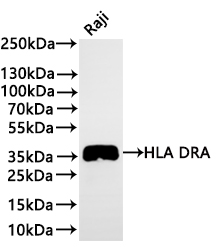
Validation in western blot applications demonstrates reliable detection in Raji whole cell lysate, a well-characterized B lymphoblastoid cell line with robust MHC class II expression. The observed band at approximately 35 kDa, compared to the predicted 29 kDa molecular weight, reflects the glycosylated state of the mature protein as it exists in cellular contexts. Recommended working dilutions of 1:500 to 1:2000 for western blotting provide flexibility to optimize signal-to-background ratios for your specific experimental conditions, with additional utility confirmed for ELISA applications.
This antibody serves researchers exploring immune cell biology, cancer immunotherapy mechanisms, and inflammatory disease pathways where MHC class II expression patterns inform both basic understanding and therapeutic development.
There are currently no reviews for this product.





