
Call us
301-363-4651 (Available 9 a.m. to 5 p.m. CST from Monday to Friday)

| Code | CSB-RA012365MA1HU |
| Size | US$210 |
| Order now | |
| Image |
|
| Have Questions? | Leave a Message or Start an on-line Chat |
| Application | Recommended Dilution |
|---|---|
| FC | 1:20-1:200 |
KIR3DL2, also designated CD158k, belongs to the killer cell immunoglobulin-like receptor family and plays a critical role in regulating natural killer cell function through recognition of MHC class I molecules. This inhibitory receptor has garnered significant research interest in immunology, particularly in studies examining NK cell education, tumor immunosurveillance, and certain T-cell lymphomas where KIR3DL2 serves as both a diagnostic marker and therapeutic target.
This recombinant monoclonal antibody, clone 8D10, offers researchers the consistency and reliability that comes with sequence-defined production. Unlike traditional hybridoma-derived antibodies, recombinant technology ensures lot-to-lot reproducibility, allowing you to generate comparable data across extended studies without concerns about antibody drift or batch variation. The human IgG1 isotype format and affinity chromatography purification deliver a reagent ready for demanding experimental workflows.
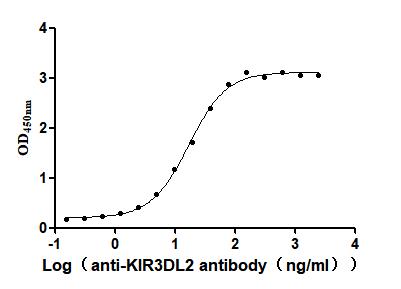
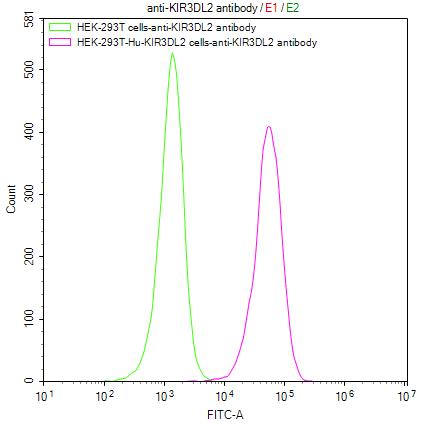
Validation studies demonstrate robust performance in flow cytometry applications, where the antibody clearly distinguishes KIR3DL2-expressing cells from negative populations. Testing with HEK-293T cells stably transfected with human KIR3DL2 showed strong positive staining compared to untransfected controls, confirming specificity for the target. Functional ELISA data further supports binding activity, with EC50 values in the 14.18–23.93 ng/mL range against immobilized recombinant human KIR3DL2 protein, indicating high-affinity target recognition.
For flow cytometry experiments, dilutions ranging from 1:20 to 1:200 provide flexibility to optimize signal-to-noise ratios across different sample types and instrument configurations. The unconjugated format allows pairing with your preferred secondary detection system for multicolor panel design. This antibody supports investigations into NK cell biology, immune checkpoint mechanisms, and lymphoma research where KIR3DL2 expression patterns inform both basic science and translational applications.
There are currently no reviews for this product.





