
Call us
301-363-4651 (Available 9 a.m. to 5 p.m. CST from Monday to Friday)

| Code | CSB-RA012936MA1HU |
| Size | US$210 |
| Order now | |
| Image |
|
| Have Questions? | Leave a Message or Start an on-line Chat |
| Application | Recommended Dilution |
|---|---|
| WB | 1:500-1:2000 |
| IHC | 1:50-1:200 |
LILRA4, also known as ILT7, serves as a highly specific surface marker for plasmacytoid dendritic cells, making it an invaluable target for researchers investigating innate immunity, type I interferon responses, and autoimmune pathologies. This receptor plays a critical role in regulating pDC activation and has emerged as a key focus in studies of lupus, viral infections, and cancer immunology where plasmacytoid dendritic cell function is implicated.
This recombinant monoclonal antibody, clone 24F6, offers the reproducibility and consistency that demanding immunology research requires. Generated against recombinant human LILRA4 protein and produced with human IgG1 framework, the antibody provides sequence-defined specificity that eliminates the lot-to-lot variability often encountered with traditional hybridoma-derived reagents. Affinity chromatography purification ensures high purity for sensitive downstream applications.
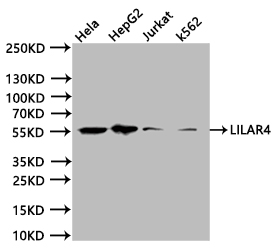
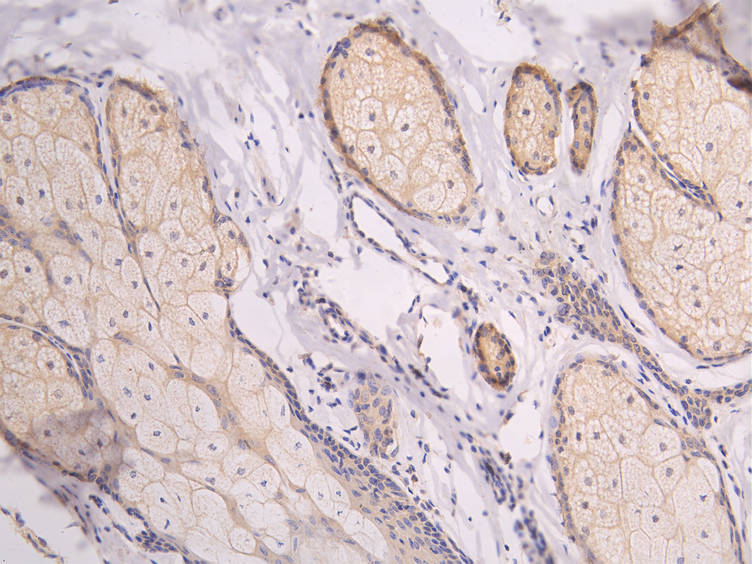
Validation studies demonstrate reliable performance across multiple experimental platforms. Western blot analysis exhibits at approximately 50 kDa band in human cell lines including HeLa, HepG2, Jurkat, and K562 whole cell lysates, with recommended dilutions ranging from 1:500 to 1:2000. The observed ~50 kDa band aligns closely with LILRA4's predicted molecular weight (~48 kDa), indicating the antibody specifically recognizes the target protein, likely reflecting its unmodified core size or a slightly truncated isoform. Immunohistochemistry validation in paraffin-embedded human skin tissue confirms utility for tissue-based studies, with optimal staining achieved at 1:50 to 1:200 dilutions following citrate buffer antigen retrieval.
Whether you are characterizing plasmacytoid dendritic cell populations, investigating interferon regulatory pathways, or exploring LILRA4 expression in disease contexts, this antibody provides a dependable tool for advancing your immunology research.
There are currently no reviews for this product.





