
Call us
301-363-4651 (Available 9 a.m. to 5 p.m. CST from Monday to Friday)

| Code | CSB-RA560532A0HU |
| Size | US$210 |
| Order now | |
| Image |
|
| Have Questions? | Leave a Message or Start an on-line Chat |
| Application | Recommended Dilution |
|---|---|
| WB | 1:500-1:2000 |
| IF | 1:50-1:200 |
| FC | 1:50-1:200 |
Lumican is a small leucine-rich proteoglycan that plays essential roles in collagen fibrillogenesis, tissue organization, and extracellular matrix assembly. Beyond its structural functions, lumican has emerged as a significant player in wound healing, corneal transparency, and tumor microenvironment regulation, making it a compelling target for researchers investigating fibrosis, cancer progression, and connective tissue biology.
This recombinant monoclonal antibody, clone 17F4, offers the reproducibility and consistency that demanding experimental workflows require. Generated through recombinant technology with a sequence-defined rabbit IgG framework, it eliminates the lot-to-lot variability that can compromise longitudinal studies and multi-site collaborations. The antibody is raised against a synthetic peptide derived from human lumican and purified by affinity chromatography to ensure high specificity.
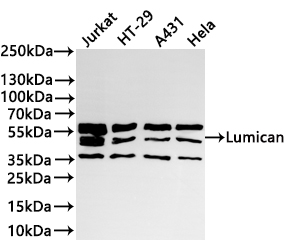
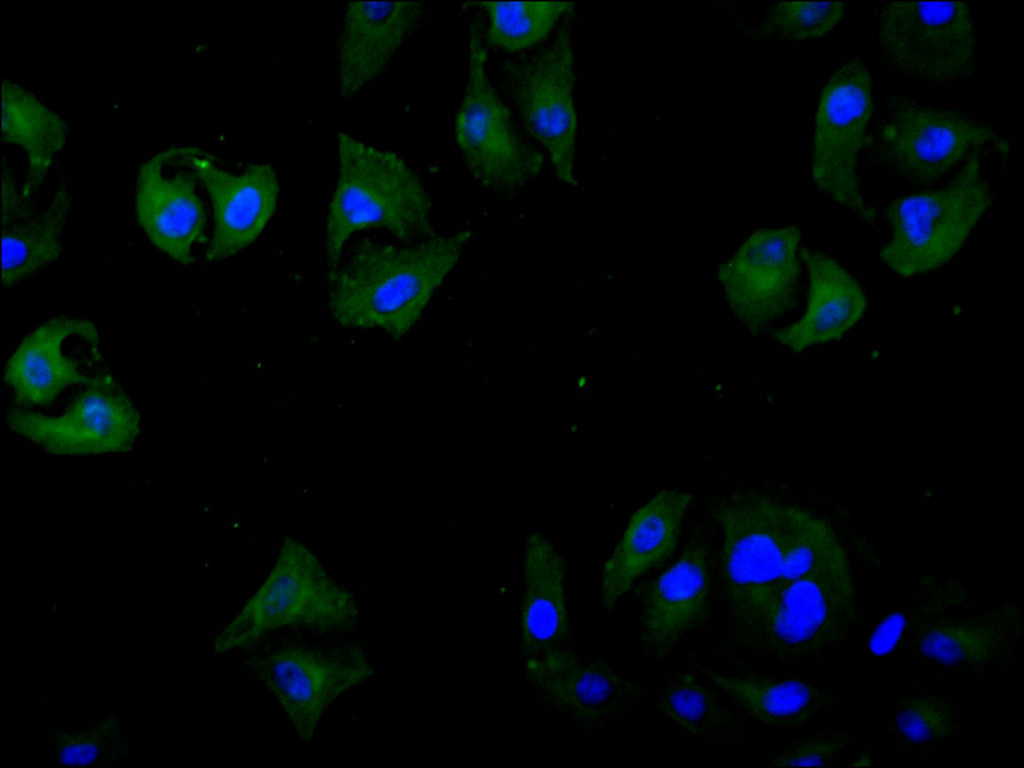
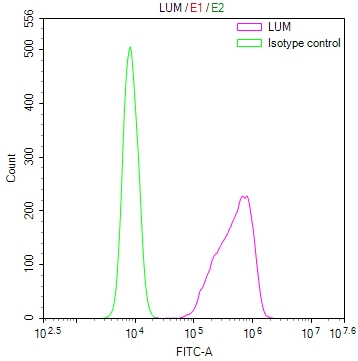
Validation studies demonstrate robust performance across multiple applications. In western blot analysis, the antibody detects lumican in Jurkat, HT-29, A431, and HeLa whole cell lysates at dilutions of 1:500–1:2000. The observed band size of 38–58 kDa, compared to the predicted 38 kDa molecular weight, reflects the extensive glycosylation characteristic of this keratan sulfate proteoglycan. Immunofluorescence staining of HeLa cells reveals clear cytoplasmic and extracellular matrix localization, while flow cytometry analysis confirms reliable detection in fixed and permeabilized cell populations.
This versatility across western blot, immunofluorescence, flow cytometry, and ELISA applications provides researchers with flexibility to characterize lumican expression through complementary approaches. Whether investigating stromal-epithelial interactions in cancer models, studying corneal pathology, or exploring fibrotic disease mechanisms, this antibody delivers the consistent performance needed for meaningful experimental insights.
There are currently no reviews for this product.





