
Call us
301-363-4651 (Available 9 a.m. to 5 p.m. CST from Monday to Friday)

| Code | CSB-RA990134A0HU |
| Size | US$210 |
| Order now | |
| Image |
|
| Have Questions? | Leave a Message or Start an on-line Chat |
| Application | Recommended Dilution |
|---|---|
| WB | 1:500-1:5000 |
| IHC | 1:50-1:200 |
MAPKAPK2, also known as MK2, serves as a critical downstream effector of the p38 MAPK signaling pathway, playing essential roles in inflammatory responses, cell cycle regulation, and stress-induced gene expression. This kinase has emerged as a significant target in cardiovascular research and signal transduction studies, particularly for investigators exploring therapeutic interventions in inflammatory diseases and cardiac pathology.
This recombinant rabbit monoclonal antibody, clone 4H8, offers the reproducibility and consistency that demanding research applications require. Generated against a synthetic peptide derived from human MAPKAPK2 and produced through recombinant technology, this antibody provides sequence-defined specificity with minimal lot-to-lot variation, ensuring your experimental results remain comparable across extended studies.
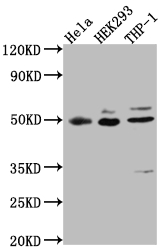
Validation in western blot applications demonstrates reliable detection of MAPKAPK2 across multiple human cell lines, including HeLa, HEK293, and THP-1 whole cell lysates at dilutions ranging from 1:500 to 1:5000. The observed band at approximately 49 kDa runs slightly higher than the predicted molecular weights of 43-46 kDa, a shift commonly attributed to post-translational modifications such as phosphorylation, which is particularly relevant given MAPKAPK2's role as an active kinase in cellular signaling cascades.
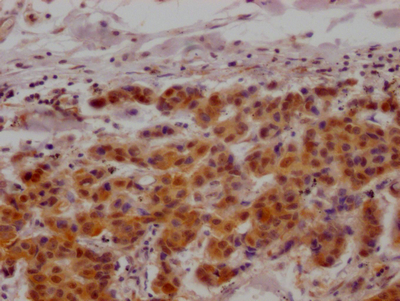
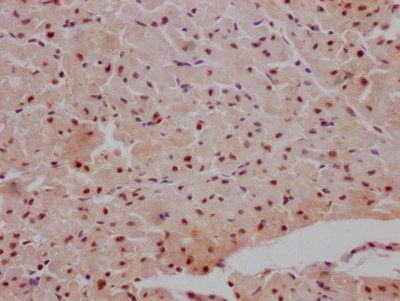
For tissue-based investigations, immunohistochemistry validation confirms strong performance in paraffin-embedded human samples, with successful staining demonstrated in both breast cancer tissue and heart tissue at 1:50 to 1:200 dilutions using citrate buffer antigen retrieval. This versatility across ELISA, western blot, and immunohistochemistry platforms provides flexibility for researchers investigating MAPKAPK2 in cardiovascular disease models, inflammatory signaling pathways, and oncology applications where stress-activated kinase signaling contributes to disease progression.
There are currently no reviews for this product.





