
Call us
301-363-4651 (Available 9 a.m. to 5 p.m. CST from Monday to Friday)

| Code | CSB-RA731035MA1HU |
| Size | US$210 |
| Order now | |
| Image |
|
| Have Questions? | Leave a Message or Start an on-line Chat |
| Application | Recommended Dilution |
|---|---|
| WB | 1:500-1:2000 |
| FC | 1:50-1:200 |
METRNL, also known as Meteorin-like protein or Subfatin, has emerged as a compelling target in metabolic and immunological research. This secreted cytokine plays important roles in energy homeostasis, thermogenesis, and inflammatory responses, with studies linking it to adipose tissue browning, insulin sensitivity, and immune cell modulation. Its involvement in these interconnected pathways makes METRNL a valuable focus for researchers investigating metabolic disorders, obesity, and inflammatory conditions.
This recombinant monoclonal antibody, clone 18C10, offers the consistency and reliability that demanding experimental workflows require. Produced through recombinant technology with a defined sequence, it eliminates the lot-to-lot variability that can compromise longitudinal studies or multi-site collaborations. The human IgG1 isotype format and affinity-chromatography purification ensure high specificity for human METRNL detection.
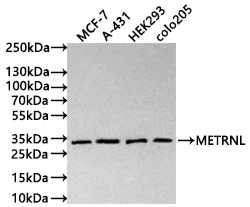
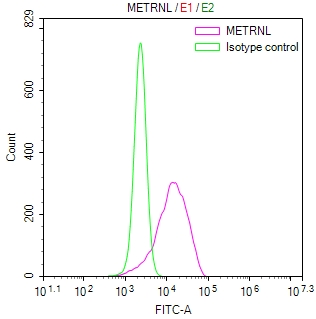
Validation across multiple platforms demonstrates this antibody's versatility in your research toolkit. Western blot analysis confirms robust detection of METRNL at the expected 34 kDa molecular weight across diverse human cell lines, including MCF-7 breast adenocarcinoma, A-431 epidermoid carcinoma, HEK293 embryonic kidney, and Colo205 colorectal adenocarcinoma cells, with optimal performance at dilutions between 1:500 and 1:2000. Flow cytometry validation in HeLa cells shows clear separation from isotype control, enabling intracellular detection of METRNL following fixation and permeabilization, with recommended dilutions of 1:50 to 1:200. ELISA compatibility further extends its utility for quantitative applications.
Whether you are exploring METRNL's role in adipocyte biology, investigating its immunomodulatory functions, or characterizing its expression patterns across cell types, this antibody provides a dependable tool for advancing your understanding of this metabolically significant protein.
There are currently no reviews for this product.





