
Call us
301-363-4651 (Available 9 a.m. to 5 p.m. CST from Monday to Friday)

| Code | CSB-RA010429A16me1HU |
| Size | US$210 |
| Order now | |
| Image |
|
| Have Questions? | Leave a Message or Start an on-line Chat |
| Application | Recommended Dilution |
|---|---|
| IF | 1:30-1:200 |
Histone H4 lysine 16 monomethylation represents a critical epigenetic mark that influences chromatin structure and gene regulation. This modification at K16 plays a distinct role in transcriptional control and DNA damage response pathways, making it an important target for researchers investigating chromatin dynamics, epigenetic inheritance, and nuclear signaling mechanisms.
This recombinant monoclonal antibody, clone 3E11, offers significant advantages for epigenetic research through its sequence-defined production in rabbit host. The recombinant format ensures exceptional lot-to-lot consistency, which is particularly valuable when studying subtle histone modifications where reproducibility is essential for meaningful data interpretation. Raised against a synthesized peptide and purified by affinity chromatography, this antibody delivers the specificity required for detecting monomethylation at this precise lysine residue.
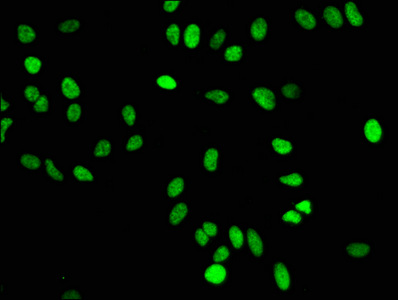
Validation through immunofluorescence demonstrates clear nuclear localization in HeLa cells, with the antibody performing effectively at dilutions ranging from 1:30 to 1:200. The staining protocol, utilizing formaldehyde fixation and Triton X-100 permeabilization, produced well-defined nuclear signals when counterstained with DAPI, confirming the antibody's ability to access chromatin-associated targets in fixed cell preparations. This validation supports applications in cellular imaging studies examining histone modification patterns and their spatial distribution within the nucleus.
With documented cross-species reactivity for human and rat samples, this antibody provides flexibility for researchers working across different model systems. The unconjugated format allows pairing with secondary antibodies of choice, accommodating various detection strategies. Whether investigating chromatin remodeling, transcriptional regulation, or the interplay between histone modifications and cellular processes, this antibody serves as a reliable tool for advancing epigenetic and nuclear signaling research.
There are currently no reviews for this product.





