
Call us
301-363-4651 (Available 9 a.m. to 5 p.m. CST from Monday to Friday)

| Code | CSB-RA225569A0HU |
| Size | US$210 |
| Order now | |
| Image |
|
| Have Questions? | Leave a Message or Start an on-line Chat |
| Application | Recommended Dilution |
|---|---|
| IF | 1:20-1:200 |
NFE2L2, commonly known as NRF2, serves as a master regulator of the cellular antioxidant response, orchestrating the expression of cytoprotective genes that defend against oxidative stress and electrophilic damage. This transcription factor plays a central role in maintaining cellular redox homeostasis and has emerged as a critical focus in cardiovascular disease research, metabolic disorders, and studies of cellular stress responses. Understanding NRF2 dynamics—its nuclear translocation, activation, and regulation—provides essential insights into how cells adapt to environmental challenges.
This recombinant monoclonal antibody, clone 2D12, offers the reproducibility and consistency that demanding research protocols require. Because it is produced from a defined genetic sequence rather than traditional hybridoma methods, you can expect uniform performance across experiments and between lots, eliminating a common source of variability in longitudinal studies. The rabbit IgG format, generated against a synthetic peptide derived from human NRF2, provides reliable detection in human samples.
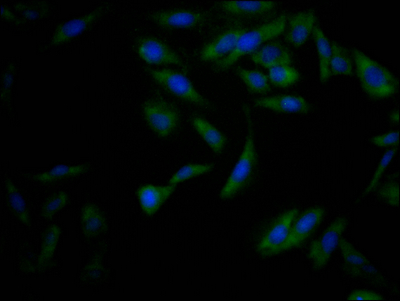
Validation through immunofluorescence microscopy in HeLa cells demonstrates clear nuclear and cytoplasmic staining patterns at 1:50 dilution, with DAPI counterstaining confirming subcellular localization. This makes the antibody particularly well-suited for investigating NRF2 translocation events in response to oxidative stressors or pharmacological activators. The antibody is also validated for ELISA applications, with recommended IF dilutions ranging from 1:20 to 1:200, allowing flexibility in optimization for your specific experimental conditions.
Whether you are investigating epigenetic regulation of stress responses, exploring NRF2's role in cardiovascular protection, or characterizing metabolic pathway interactions, this antibody provides a dependable tool for advancing your research into this essential cellular defense pathway.
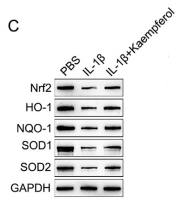
Applications : Immunoblotting
Sample type: cells
Review: immunoblotting revealed that IL- 1β stimulation reduced the mRNA and protein levels of the anti-oxidative factors Nrf2, HO-1, NQO-1, SOD1, and SOD2,but kaempferol only partially mitigated IL-1-β induced oxidative changes.
By Anonymous





