
Call us
301-363-4651 (Available 9 a.m. to 5 p.m. CST from Monday to Friday)

| Code | CSB-RA213932A0HU |
| Size | US$210 |
| Order now | |
| Image |
|
| Have Questions? | Leave a Message or Start an on-line Chat |
| Application | Recommended Dilution |
|---|---|
| IHC | 1:50-1:200 |
Platelet-derived growth factor receptor beta (PDGFRB) serves as a critical receptor tyrosine kinase that orchestrates cellular responses to PDGF signaling, playing fundamental roles in angiogenesis, wound healing, and mesenchymal cell proliferation. Its dysregulation has been implicated in various pathological conditions, including tumor progression and cardiovascular disease, making it an important target for researchers investigating both normal developmental processes and disease mechanisms.
This recombinant monoclonal antibody, generated against a synthetic peptide derived from human PDGFRB, offers the consistency and reliability that demanding experimental workflows require. Because the antibody sequence is defined and produced recombinantly in rabbit host cells, researchers benefit from lot-to-lot reproducibility that traditional hybridoma-derived antibodies cannot guarantee. This consistency is particularly valuable for longitudinal studies or when establishing standardized protocols across research teams.
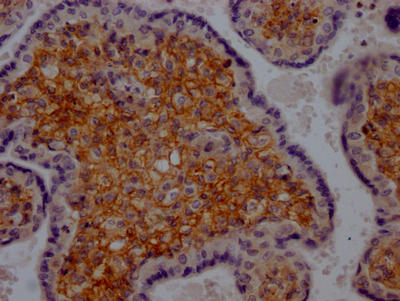
The antibody has been validated for immunohistochemistry applications, with successful staining demonstrated in paraffin-embedded human placenta tissue at 1:100 dilution using citrate buffer antigen retrieval. This validation in placental tissue is particularly relevant given PDGFRB's known expression in vascular and stromal compartments. The recommended working dilution range of 1:50 to 1:200 for immunohistochemistry provides flexibility for optimization across different tissue types and detection systems. Additional validation for ELISA applications extends the utility of this reagent for quantitative studies.
Supplied in a stabilized liquid format with glycerol for convenient long-term storage, this antibody is well-suited for investigations spanning cancer biology, cardiovascular research, and signal transduction studies where reliable PDGFRB detection is essential for advancing experimental objectives.
There are currently no reviews for this product.





