PDIA6 Recombinant Monoclonal Antibody

Code CSB-RA965109A0HU
Size US$210
Order now
Image
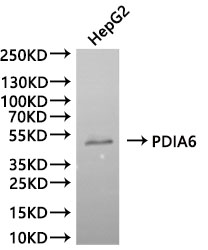
  • Western Blot
    Positive WB detected in:HepG2 whole cell lysate(30µg)
    All lanes: PDIA6 antibody at 1:1000
    Secondary
    Goat polyclonal to rabbit IgG at 1/40000 dilution
    Predicted band size: 48 kDa
    Observed band size: 48 kDa
    Exposure time:30s
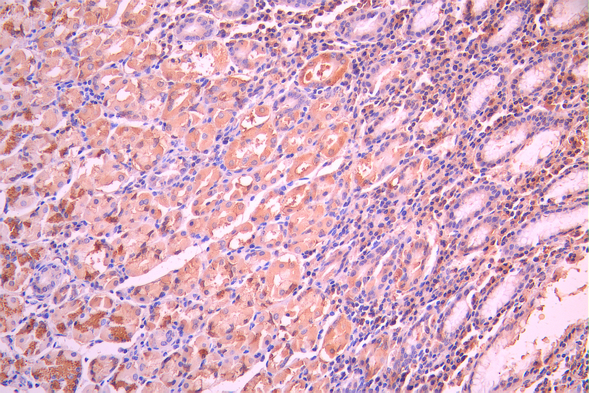
  • IHC image of CSB-RA965109A0HU diluted at 1:100 and staining in paraffin-embedded human stomach tissue performed on a Leica BondTM system. After dewaxing and hydration, antigen retrieval was mediated by high pressure in a citrate buffer (pH 6.0). Section was blocked with 10% normal goat serum 30min at RT. Then primary antibody (1% BSA) was incubated at 4°C overnight. The primary is detected by a Goat anti-rabbit polymer IgG labeled by HRP and visualized using 0.05% DAB.
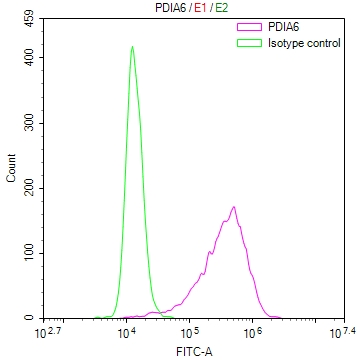
  • Overlay Peak curve showing HepG2 cells stained with CSB-RA965109A0HU (red line) at 1:100. The cells were fixed in 4% formaldehyde and permeated by 0.2% TritonX-100 for 10min. Then 10% normal goat serum to block non-specific protein-protein interactions followed by the antibody (1ug/1*106cells) for 45min at 4℃. The secondary antibody used was FITC-conjugated goat anti-rabbit IgG (H+L) at 1/200 dilution for 35min at 4℃.Control antibody (green line) was Rabbit IgG (1ug/1*106cells) used under the same conditions. Acquisition of >10,000 events was performed.
Have Questions? Leave a Message or Start an on-line Chat

Product Details

Uniprot No.
Target Names
Alternative Names
Protein disulfide-isomerase A6 (EC 5.3.4.1) (Endoplasmic reticulum protein 5) (ER protein 5) (ERp5) (Protein disulfide isomerase P5) (Thioredoxin domain-containing protein 7), PDIA6, ERP5 P5 TXNDC7
Species Reactivity
Human
Immunogen
A synthesized peptide derived from Human PDIA6 protein
Immunogen Species
Homo sapiens (Human)
Conjugate
Non-conjugated
Clonality
Monoclonal
Isotype
Rabbit IgG
Clone No.
14F3
Purification Method
Affinity-chromatography
Concentration
It differs from different batches. Please contact us to confirm it.
Buffer
Rabbit IgG in 10mM phosphate buffered saline , pH 7.4, 150mM sodium chloride, 0.05% BSA, 0.02% sodium azide and 50% glycerol.
Form
Liquid
Tested Applications
ELISA, WB, IHC, FC
Recommended Dilution
Application Recommended Dilution
WB 1:500-1:5000
IHC 1:50-1:200
FC 1:20-1:200
Troubleshooting and FAQs
Storage
Upon receipt, store at -20°C or -80°C. Avoid repeated freeze.
Lead Time
Basically, we can dispatch the products out in 1-3 working days after receiving your orders. Delivery time maybe differs from different purchasing way or location, please kindly consult your local distributors for specific delivery time.
Usage
For Research Use Only. Not for use in diagnostic or therapeutic procedures.
Customer Reviews and Q&A

 Customer Reviews

There are currently no reviews for this product.

Submit a Review here

Target Background

Function
May function as a chaperone that inhibits aggregation of misfolded proteins. Negatively regulates the unfolded protein response (UPR) through binding to UPR sensors such as ERN1, which in turn inactivates ERN1 signaling. May also regulate the UPR via the EIF2AK3 UPR sensor. Plays a role in platelet aggregation and activation by agonists such as convulxin, collagen and thrombin.
Gene References into Functions
  1. Results indicate that protein disulfide isomerase family 6 (PDIA6) overexpression promoted the proliferation of HeLa cells by suppressing the phosphorylation of beta-catenin, thereby inhibiting the degradation of beta-catenin through the ubiquitin-proteasome pathway. PMID: 27462866
  2. the chaperone 78-kDa glucose-regulated protein (GRP78) protects the MPD against PDI-dependent disulfide-bond isomerization by binding to this domain and, thereby, preventing ADAM17 inhibition. PMID: 28949004
  3. Downregulation of PDIA6 inhibited BC cell proliferation and invasion in vitro as well as tumor growth and metastasis in vivo. In addition, PDIA6 downregulation suppressed the Wnt/beta-catenin signaling pathway. PMID: 27760590
  4. Results indicate that re-expression of miR-127-3p and miR-376a-3p induces a strong tumor suppressor effect in GCTSC, which is partially mediated via COA1 and PDIA6. PMID: 28866093
  5. ACE and PDIA6 were identified as potential HSPA2-interacting proteins; this assemblage resides in membrane raft microdomains located in the peri-acrosomal region of the sperm head. PMID: 26676989
  6. Restoration of miR-127-3p and miR-376a-3p counteracts the neoplastic phenotype of giant cell tumor of bone derived stromal cells by targeting COA1, GLE1 and PDIA6. PMID: 26655997
  7. PDIA3 and PDIA6 gene expression is a neoplasm aggressiveness marker in primary ductal breast cancer. PMID: 26125904
  8. CDDP-resistant non-small lung cancer cells undergo profound remodeling of their endoplasmic reticulum (ER) proteome (>80 proteins identified by proteomics) and exhibit a dramatic overexpression of two protein disulfide isomerases, PDIA4 and PDIA6. PMID: 24464223
  9. Txnip is located in the endoplasmic reticulum and interacts with endogenous PDIA6. Txnip increases PDI activity. PMID: 24843047
  10. levels of expression of ERp5 and GRP78 correlated with the level of expression of membrane-bound MICA in chronic lymphocytic leukemia patients. PMID: 22215138
  11. Data show that the lymph node (LN) stroma displayed in situ high levels of transcription and expression of the disulfide-isomerase ERp5 and of the disintegrin-metalloproteinase ADAM10, able to shed the ligands for NKG2D (NKG2D-L) from the cell membrane. PMID: 22167753
  12. P5 forms a non-covalent complex with immunoglobulin heavy chain binding protein (BiP) and shows specificity towards BiP client proteins. PMID: 19887585
  13. observed to have peptide-binding ability, and chaperone activity was confirmed with rhodanese and citrate synthase as substrates, but not with D-glyceraldehyde-3-phosphate dehydrogenase, showing substrate specificity with respect to chaperone activity PMID: 12204115
  14. ERP5 regulates the binding of fibrinogen, cell-surface exposure of P-selectin, and coassociation of beta 3 integrin in stimulated platelets. PMID: 15466936
  15. Pharmacological inhibition of thioreductase activity and ERp5 gene silencing revealed that cell-surface ERp5 function is required for MICA shedding PMID: 17495932

Show More

Hide All

Subcellular Location
Endoplasmic reticulum lumen. Cell membrane. Melanosome.
Protein Families
Protein disulfide isomerase family
Tissue Specificity
Expressed in platelets (at protein level).
Database Links

HGNC: 30168

OMIM: 611099

KEGG: hsa:10130

STRING: 9606.ENSP00000272227

UniGene: Hs.212102

icon of phone
Call us
301-363-4651 (Available 9 a.m. to 5 p.m. CST from Monday to Friday)
icon of address
Address
7505 Fannin St., Ste 610, Room 7 (CUBIO Innovation Center), Houston, TX 77054, USA
icon of social media
Join us with

Subscribe newsletter

Leave a message

* To protect against spam, please pass the CAPTCHA test below.
CAPTCHA verification
© 2007-2026 CUSABIO TECHNOLOGY LLC All rights reserved. 鄂ICP备15011166号-1
Place an order now

I. Product details

*
*
*
*

II. Contact details

*
*

III. Ship To

*
*
*
*
*
*
*

IV. Bill To

*
*
*
*
*
*
*
*